Wednesday, May 18, 2022

Cocoa Nibs, Coffee Nibs, Licorice Nibs and His Royal Oriental Nibs - Racism and Licorice


NIB . . . A very small piece or quantity of anything.

The English Dialect Dictionary, Volume 4, M-Q, London, H. Frowde, 1903.

NIBS . . . An important or self-important person - usually in the phrases his nibs or her nibs as if a title of honor.

Meriam-Webster.com.


A rumor circulating on social media platforms since at least 2015 suggests that the name of Twizzlers’ black licorice-flavored candy, “Nibs,” is a shortened form of “n[-word] babies.” This may not be true, however, as a race-neutral sense of the word “Nib,” meaning a “very small piece or quantity of anything,” would explain the choice of the name, without resort to a speculative, racist acronym. Licorice “Nibs” are about the same size and color as “cocoa nibs” and roasted “coffee nibs,” which were known ingredients in the candy and foot processing fields when “Nibs” took their name. Any passing similarity to the word “n[-word] babies” may be mere coincidence.

The rumor, even if false, is rooted in at least one fact. Small, baby-shaped licorice candies have, in fact, been offered for sale in the United States since at least the 1880s. Those candies were frequently referred to as “n[-word] babies.” A race-neutral, alternate name, “licorice babies,” was at least as common as the problematic name by the 1900s, and became increasingly dominant as the years passed. Twizzlers’ “Nibs,” however, are not and never have been baby-shaped, and there’s no indication that they were ever marketed, or referred, to as “N[-word] Babies.” 

Surprisingly, perhaps, if “Nibs” ever has been marketed in what might now be seen as a racially inappropriate name, it was in relation to Asians, not African-Americans. Beginning in about 1930, “Nibs” were rebranded as “Oriental Nibs.” “Oriental,” in this case, likely alluded to the licorice root being widely harvested in the Middle East, as opposed to the Far East, but that did not stop some people from associating them with Asia. 


NIBS

TWIZZLERS brand NIBS are manufactured by Hershey, the chocolate company, who bought out TWIZZLERS’ parent company, Y&S in the 1970s. Y&S stood for Young & Smylie, a licorice company from Brooklyn, New York, that dates back to 1845.

Young & Smylie’s products included, Acme Licorice Pellets, a variety of wafers, lozenges and sticks, with many of them sold under the Y&S brand name.
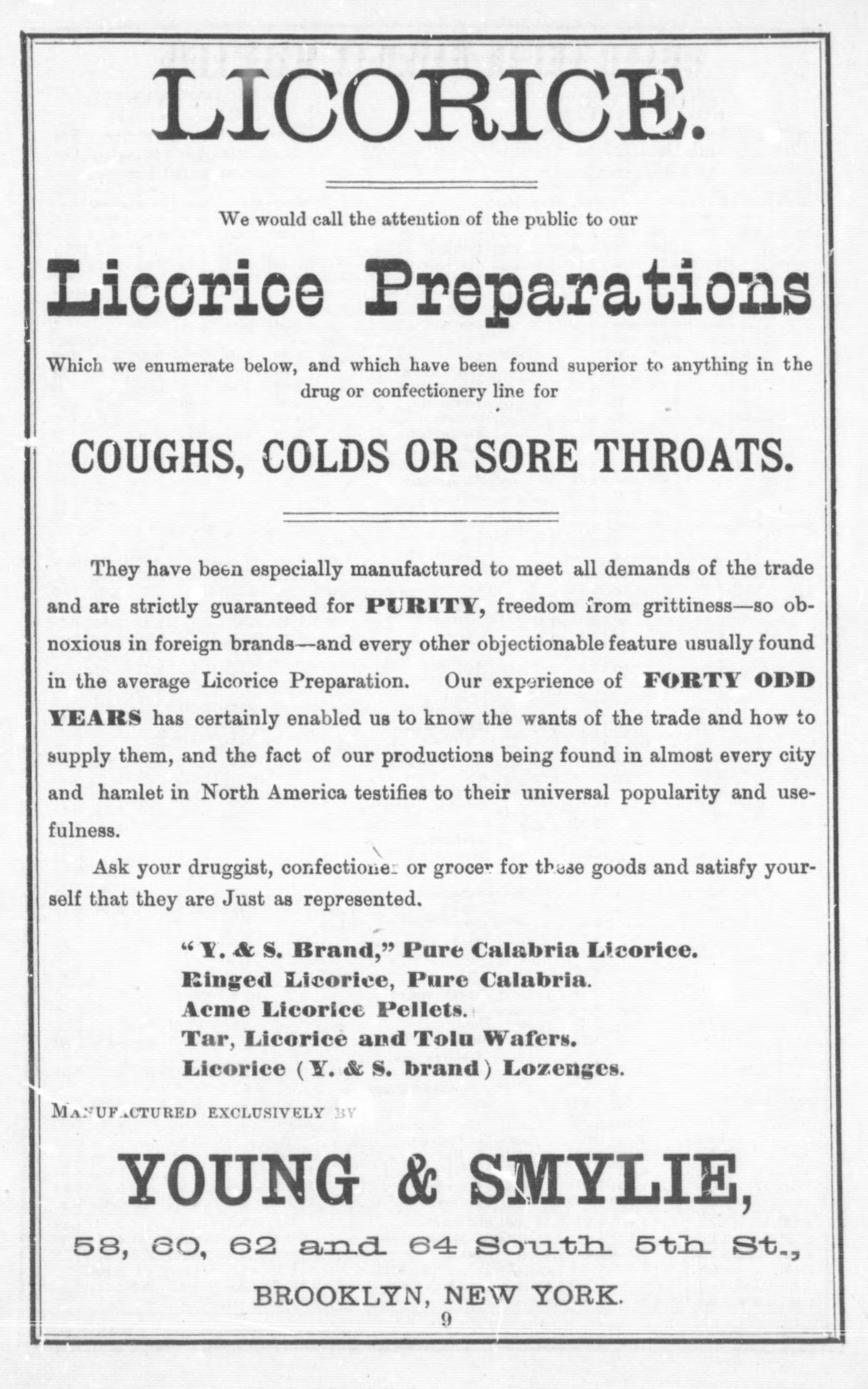
Young & Smylie advertisement, Grand Trunk RY Company of Canada, Official Time Table, 1885.


In 1902, Young & Smylie joined forces with several other licorice companies, H. W. Petherbridge, F. B. & V. P. Scudder, Stamford Manufacturing, and MacAndrews & Forbes, to form the National Licorice Company, with Charles A. Smylie as President. National Licorice changed its name to Y&S in 1968.


The National Licorice Company became entangled in anti-trust litigation, as part of the so-called “Licorice Trust.” They were also implicated in the “Tobacco Trust” litigation, since licorice paste was one of the main ingredients in plug chewing tobacco.


The Baltimore Sun, July 11, 1907, page 2.


The National Licorice Company introduced NIBS brand licorice bits in 1923.

Des Moines Tribune, November 8, 1923, page 9.


Licorice Nibs Here.

Harry S. Hays, the licorice man, is in the city introducing a new confection called Licorice Nibs. It’s the same licorice that we all loved so much when we were youngsters and with many of us the taste has never disappeared, only that we remember licorice as a stick and our personal vanity keeps us from buying and chewing licorice sticks. Now that objection is removed. Licorice Nibs, is simply our old friend licorice in a new form - in small square bits - attractive to look at and attractively packaged.

The Cedar Rapids Gazette, October 29, 1923, page 10.


Licorice NIBS are very small pieces of candy, which may explain why they were given a name that means, in one sense of the word “nibs,” a “very small piece or quantity of anything.” The word was applied to “small nibs of turfy loam,”i a “small nib of lime,”ii “small nibs of charcoal,”iii or “small nibs of coal.”iv

The word “nibs” had been used with a different type of licorice candy several years earlier. Significantly, with respect to the suggestion that NIBS is short for “N[-word] Babies”), these earlier licorice “nibs” were apparently not black on the outside, so there would have been no particular reason to refer to them by that name. The licorice was encased within “little tubes of crystal sugar,” perhaps like Good ‘n’ Plenty or licorice pastels.

Licorice Nibs. - Dainty little tubes of crystal sugar and filled with delicious licorice candy. Very tasty for those who like good licorice candy. Lb. 25c.

Asbury Park Press (Asbury Park, New Jersey), November 12, 1915, page 5.


There were also at least two other types of “nibs” commonly used in food production. Licorice NIBS are about the same size, and of a similar color (or shade), as coffee nibs and cocoa nibs, so it would not have been a stretch to apply the same name to small pieces of licorice.


Coffee Nibs.

Each [coffee] berry has two seeds usually called coffee beans or coffee nibs, and these are the coffee of commerce.

Webster’s Weekly (Reidsville, North Carolina), November 21, 1901, page 3.

Here the coffee nibs, or “beans,” have been shoveled into heaps, to dry in the hot sun.

Visual Education, Volume 4, Number 1, January 1923, page 48.


Cocoa Nibs.

To prepare the [cocoa] seeds for use, they are roasted, crushed, and winnowed to remove the husks. The husks are known in commerce as “shells”; the crushed seeds are called “cocoa-nibs”; cocoa-nibs ground to a paste makes “flaked cocoa”; flaked cocoa mixed with sugar and aromatized is “chocolate.”

Reports of the United States Commissioners to the Universal Exposition of 1889 at Paris, Washington DC, Government Printing Office, 1891, page 713.
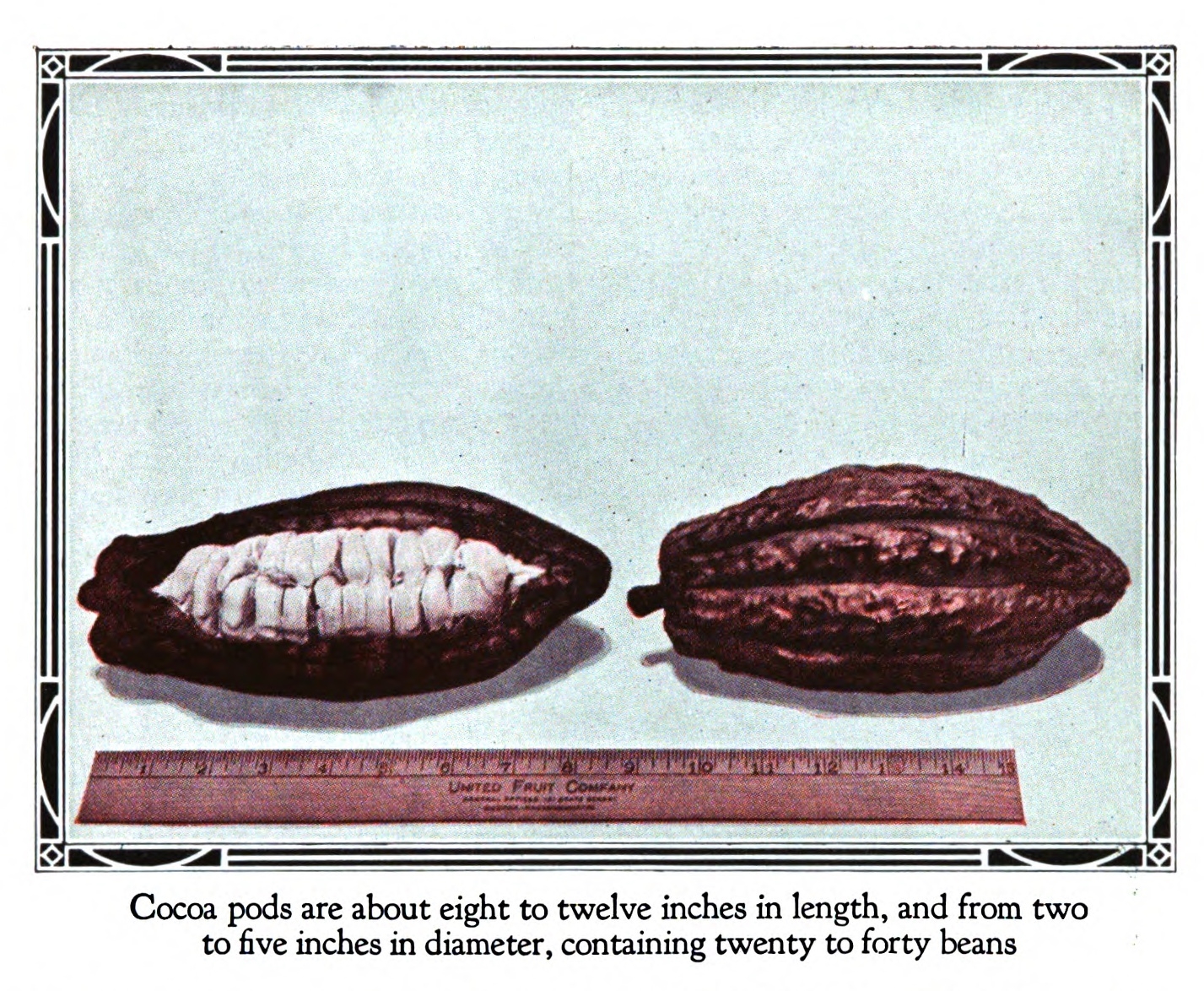
 

The Story of Chocolate and Cocoa, Hershey, Pennsylvania, Hershey Chocolate Corporation, 1926, pages 11, 19, 20.


The expression, “Cocoa Nibs,” was even used in a marketing campaign for cocoa in England. In the 1910s and ’20s, Rowntree’s (who would later develop the “Kit-Kat” bar), marketed its “Elect Cocoa” with mascots known as the “Cocoa Nibs.”


The Poster, Volume 13, Number 5, May 1, 1922, page 45.


The Cocoa Nibs held out a cup,

To cheer the poor old fellow up.

“Drink lots of this, and when you’ve done,

“You’ll have more colour than the sun.”

Lincolnshire Echo (Lincoln, England), December 18, 1919, page 2.


“His Nibs”

The brand name of licorice NIBS may not be based on “N[-word] Babies,” but the word “nibs” could be insulting in one sense of the word. “His/Her Nibs” was used ironically, as a mock-aristocratic title, to refer to an “important or self-important person.” It was frequently expanded to “His/Her Royal Nibs” or, when used with respect to someone from the “East” (Middle or Far), “His/Her Oriental Nibs.”


For example, the King of Hawaii.v


The King of England.

His Royal nibs, King Ed. the VII, had finished reading the evening papers that had been brought in by a page dressed in such gorgeous livery that so far as clothes went even General Miles would look like three worn ten cent pieces by comparison.

The Elk City Enterprise (Elk City, Kansas), March 29, 1901, page 3.


A fictional Mayor.

By Clothes-line Press. Washington D. C., March 19. - The pennyroyal train bearing His Royal Nibs, Lord Helpus ‘Rastus, Knight of the Golden Fleece, arrived at the Grand Central station here at 8:30 A. M. There was a large crowd at the station and several locomotives made considerable noise by way of salute. His Royal Nibs went to the Shoreham for Breakfast.

The Buffalo Times (Buffalo, New York), March 19, 1902, page 1.


A stage play, in which the title character, “His Royal Nibs,” was Satan - King of the Underworld.

The San Francisco Call, April 18, 1904, page 12.


Among the thousands of references to “His/Her Nibs” or “His/Her Royal Nibs,” there are a small handful (a few nibs?) of examples of “His/Her Oriental Nibs,” when the person being referred to is from the “East.”

Sunset Cox has had an interview with the Sultan of Turkey, during which they discussed the tariff question. As his Oriental Nibs is reported to have about two hundred wives, he would doubtless find the speech of the witty ex-Congressman on the tariff on corsets peculiarly interesting.

Humboldt Times (Humboldt, California), September 15, 1885, page 2.


When the Shah visited England, and went to the Gaiety Theater, London, to witness the ballet, his royal oriental nibs was filled with astonishment to find those light-heeled nymphs of the footlights arrayed very much like the ladies of his harem, back home in Tehran.

The Chicago Inter-Ocean, November 27, 1887, page 17.


His Oriental Nibs, Hadji Hassein Ghooly Khan, Embassador Extraordinary and Minister Plenipotentiary from Nasr-Ed-Din, Shah-in-Shah (King-of-Kings) of Persia, to this part of the “Wild and Wooly West,” has packed his diplomatic portfolio and departed these shores, without any leave-taking of the President or the State Department.

The National Tribune (Washington DC), July 18, 1889, page 5.


Constantinople, November 24. - United States Charge d’Affairs Griscom called upon Tewifik Pasha, Minister for Foreign Affairs, yesterday to urge a settlement of the difficulty in relation to granting of an exaquatur to Dr. Thomas H. Norton, who some time ago was appointed by President McKinley to establish a consulate at Harpoot. The Porte is firm in its refusal to grant an exequatur.

Stockton Daily Evening Record (Stockton, California), November 24, 1900, page 8.


He says he can’t abide his Oriental Nibs, but as [the Hindu mystic, Swami Lal Singh] is a friend of Mrs. Stevenson’s he has to swallow him.

“‘Where’s Emily?’A Serial Mystery Story,” Carolyn Wells, Herald and Review (Decatur, Illinois), September 27, 1927, page 4.


“Where’s Emily?” would again be widely published throughout the United States in 1930. That same year, the National Licorice Company’s hometown newspaper, The New York Daily News, exposed a fake-prince’s return to New York under an assumed name, several years after first being deported under his previous assumed name. He was apparently a sort of high-end gigolo, ingratiating himself with wealthy women who bathed in the glow of his exotic fake-titles and regal bearing.


He did not choose this title for himself, but the New York Daily News referred to him as “his royal Oriental Nibs.”


His royal highness, Prince Mohamid Pasha, descendant of ancient Egyptian kings, is honoring New York with his regal Oriental presence. . . .

Whispers of the Oriental potentate’s presence came to The News. This investigator took one look and, strangely enough, found Prince Pasha to bear a remarkably close resemblance to none other than the quince prince Zerdecheno of 1922, 1924 and 1925; formerly exposed by The News as an erstwhile pants presser, book salesman, hotel heat and general all-around four-flusher.

Deported by the immigration authorities after his last visit here in 1925, when The News had exposed and nipped his royal pretensions for the second time, the self-styled prince of Kurdistan and scion of the Pharaohs has bounced back again with a new title, but evidently with the same old tricks up his sleeve. . . .

A request to see the passport brought a laconic, “Some othair day - later, perhaps,” from his royal, Oriental nibs.

The New York Daily News, March 10, 1930, page 3.


This time he would get to stay in the United States, but only after finally admitting (and proving) that he had been born in Detroit.

But that didn’t end his charade. A decade or so later, he was hauled into court on charges of disorderly conduct, related to a fight with the husband of one of his companions during her divorce proceedings.


A cane-swinging duelvi over red-headed Irene Hendy, above, mother of a 15-year old boy, caused the self-appointed Emir of Kurdistan to be presented at court himself in Long Island City.

El Paso Times (Texas), The Sunday Home Magazine, September 20, 1942.


He was found not guilty, in part on the strength of a love letter from his married girlfriend - or ex-girlfriend; during the trial she referred to him as an “imbecile.” A reporter who recognized him during the trial quoted him as having said,


“It is humiliating to acknowledge I was born in Detroit.”


“Oriental Nibs”

By the end of 1930, the National Licorice Company had rebranded its NIBS as “Oriental NIBS. Was the change an allusion to the mock- aristocratic sense of “His Nibs”? Or simply an added element of exoticism for marketing purposes? Was the change influenced by a fake Turkish “Prince” who was in the news in 1930 and 1931? Or reprints of “Where’s Emily?” It’s not clear why the National Licorice Company rebranded “Nibs” as “Oriental NIBS that year, but the new name was at least suggestive of “His Oriental Nibs,” and of the “Oriental” origins of licorice, whether they knew it or not.

Cedar Rapids Gazette, November 1, 1923, page 8.


When introduced in 1923, National Licorice’s NIBS featured images of Egyptian pyramids and palm trees on its packaging. If that seems kinda random, it might be explained by the fact that the world was then in the grips of “Tut-mania,” in the wake of the discovery of King Tut’s tomb in November 1922 by Howard Carter and The Earl of Carnarvon.

King Tut’s name was “plastered” “here, there ‘n everywhere” in marketing and advertising the following year.

The “King Tut” label is going to be plastered on half a hundred articles of merchandise this summer. . . . “King Tut” dresses, “King Tut” suits for men, “King Tut” marcelle waves, “King Tut” candies, “King Tut” labels for canned fruit and vegetables, “King Tut” patent medicines, “King Tut” corn remedy, are among the things either already or soon to be placed on the market . . . .

The Columbus Telegram (Columbus, Nebraska), April 19, 1923, page 3.


International Confectioner, March 1923, page 49.


Whether National Licorice had this in mind or not, King Tut’s name was even more appropriate for use with respect to its licorice candy, than merely reflecting the King Tut-obsessed Zeitgeist, as was the case with most other products.


Even the famous King Tut was tucked away with licorice root in his tomb. 

Chicago Tribune, January 11, 1935, page 18.


The Record (Hackensack, New Jersey), June 22, 1953, page 23.


Later NIBS packaging also featured images of camels, which were directly related to the history of cultivating licorice. At one time, much of the licorice imported to the United States was transported by camel from its source to initial processing facilities.

The principal articles of export from Smyrna to the United States are licorice root, emery stone, figs, opium, canary seed, carpets and rugs . . . . During the last quarter nearly $50,000 of licorice root has been sent to America. . . . The Stamford manufacturing company of Connecticut is a large exporter of this root. It comes to Smyrna in huge bales loaded on camels.

Hartford Courant (Hartford, Connecticut), November 27, 1885, page 1.


National Licorice had the good sense not to use the name of King Tut, just King Tut-adjacent, Egyptian imagery, so its packaging remained relevant even after King Tut faded from the headlines.

In about 1930, the National Licorice Company rebranded NIBS as “Oriental” NIBS. Although the word “Oriental” has fallen into disfavor, and might be interpreted as problematic if used today, at the time, it was understood as referring to something from the “East” (the word comes ultimately from Latin, orientalis, “of or belonging to the east”vii). The word was most frequently used with respect to the Far East, but was also used with respect to the Middle East.


Salt Lake Telegram (Utah), December 20, 1930, page 25.


The Ottawa Citizen (Ottawa, Ontario), September 25, 1931, page 20.


The Statesman Journal (Salem, Oregon), May 10, 1935, page 8.


Although the pyramids and camels were strictly Middle Eastern, another element of the packaging may have been more suggestive of the Far East. The font used for the word “Oriental” on NIBS’ packaging seems similar to stylistic “Chinese” fonts, like those known as Mandarin or Wonton.


Although originally “Oriental” only in the Middle Eastern sense, some people associated “Oriental” NIBS fondly with the Far East. A Chinese family from New York City, for example, celebrated “Chinese New Year” with “Oriental licorice . . . Nibs.” When they moved to Florida, and couldn’t find them in the stores, so they wrote to the newspaper for advice in where to find them.

Chinese of Brevard:

Happy New Year to All.

We are a Chinese family from New York. Our family tradition around New Year’s has been to surprise each other with miniature packages of goodies as candied ginger, lichee nuts and Oriental licorice. We are well supplied with the first two items but have been unable to find a particular licorice brand called Nibs. Can you find them for us? And may the year 4667, the Year of the Fowl, bring you prosperity.

Ling Tsun, Indian Harbour Beach

Florida Today (Cocoa, Florida), February 14, 1969, page 1C.


“Licorice Babies”/“N[-word] Babies”

TWIZZLERS’ NIBS may not have been originally called “N[-word] Babies,” but there were, in fact, licorice flavored candies that were called “N[-word] Babies,” from at least as early as 1883.

J. B. Whitehill’s store is headquarters for fancy and plain candies, such as . . . n[-word babies, O. F. L. drops, gum babies, licorice drops, mint lozengers, O. H. drops and stick candies of all kinds.

The Jeffersonian-Democrat (Brookville, Pennsylvania), October 24, 1883, page 3.


This early example does not unambiguously show that the candies were baby-shaped; nor does one a few years later, although the differentiation between “licorice drops” and “n[-word] babies” suggests that perhaps they were.

Special Sale of Candy.

Mixed candy . . . red hots, cocoa beans, maple beans, cachone, cinnamon imperials at 50c per box or 15c per lb: licorice drops, n[-word] babies, peanut bar, maple sugar, 10c per lb. . . .

Davenport Morning Star (Davenport, Iowa), November 29, 1890, page 4.


A few years later, another example more directly states that the candies are “in the form of” babies.

CHILDREN GET SICK.

They Buy All Sorts of Confections and Trouble Results.

 . . . The youngsters in these days have, pennies, nickels and even dimes, and they are not slow in imitating their elders by way of astonishing their inner man with all sorts of indigestible things. . . . Various kinds of gaudily wrapped gum, warranted to cure dyspepsia, headache, dizziness, etc.; licorice in the form of n[-word] babies, or long black sticks that look as inviting as railroad spikes or cold weinerwurst . . . .

Quad-City Times (Davenport, Iowa), February 10, 1894, page 1.


Early references to the candy (before 1900) all use the name, “n[-word] babies,” whereas after 1900, the name, “licorice babies” seems to have been used at least as often, and to have become increasingly dominant over the years.

The booby prize, which was a small licorice baby, was won by Miss Clara Kirchner and Geo. A. McGrath.

The Marion Star (Marion, Ohio), January 31, 1900, page 8.


Licorice babies, by any name, became part of the pop-culture, beyond the candy. In 1901, Mose Gumble wrote the song, “I Loves My Licorice Baby,” although n this instance (presumably), the “Licorice Baby” was a black woman, not the candy.

A widely circulated, viral joke in the 1910s called them “licorice babies.”

She Didn’t Care

Kind Old Lady - While you were gone, little girl, a bad boy came up to the porch and ran away with your licorice babies.

Little Girl - Oh, I don’t care much.

Kind Old Lady - But he ate them all up.

Little Girl - Then he’ll be sorry, ‘cause they wasn’t licorice babies. I made ‘em out of tar.

Los Angeles Evening Express, August 14, 1914, page 12.


The Boston Globe, August 20, 1914, page 14.


In Camden, New Jersey, the home of the MacAndrews & Forbes licorice manufacturing plant, the company’s sports teams (baseball, basketball, and bowling) were all known as the “Licorice Babies,” and their baseball team played at “Licorice Ball Park.”

“Licorice babies” were the focus of a game played at children’s parties, as described Mrs. Elizabeth Thompson’s “Heart and Home Problems” advice column.

You could have small licorice candy babies secreted all over the rooms and have a hunt and give a small prize to the one who discovers the greatest number.

The Evening News (Wilkes-Barrre, Pennsylvania), October 14, 1913, page 7.

Although sometimes, the game went by a different name.

A “n[-word] baby” hunt was one of the features of the evening. Miss Rhea Jones won the first prize and Harry Holloway the booby.

The Piqua Daily Call (Piqua, Ohio), August 28, 1903, page 8.


But even where race-neutral name was used for the candy, the game might go by a different racially problematic name.

Music and charades and a “coon hunt” with the little licorice babies as the trophies of the hunt, made a deal of merriment after a business meeting, and before a dainty supper.

The Hutchinson Gazette (Hutchinson, Kansas), May 13, 1914, page 6.


In a syndicated children’s story, the child-protagonists, Nick and Nancy, ran across “N[-word] Babies” in “Sugar Plum land.”

The Tulsa Tribune (Tulsa, Oklahoma), May 27, 1923, Magazine Section.


The little black men were licorice n[-word]-babies and their wig-wams were empty ice-cream cones turned upside down!

 The Richmond Item (Richmond, Indiana), April 8, 1923, page 8.


A few years later, in another syndicated children’s story, the “Tinymites” got into a marshmallow fight with the “Goofy Goos” in the “gum drop hills.” Two episodes later, we learn that the “Goofy Goos” are actually “licorice babies.”

“The Tinymites,” story by Hal Cochran and pictures by Knick, Santa Ana Register (Santa Ana, California), July 27, 1927, page 13.


“King Lollipop” acts as peacemaker.

 Santa Ana Register, July 28, 1927, page 13.


The Goofy-Goos were queer to see, as black as anyone could be. Said Clowny, “Say, who are you tots, and why do you live here?”

“We’re Licorice candy,” one replied. “In candy stores we’re often spied. Of course we’re very harmless, we bring no cause for fear.”

The Coppy laughed aloud and said, “You all know how to raise much Ned. I think you fought a dandy fight with us a while ago.” A licorice baby, ‘mid a grin, replied, “We did not hope to win.”

Santa Ana Register, July 29, 1927, page 27.


Baby-shaped, licorice candy would continue being sold under a variety of names, some neutral, some bad or worse.

The Pittsburgh Press, September 29, 1932, page 19.


The Life (Berwyn, Illinois), January 19, 1934, page 3.


 Lancaster New Era (Lancaster, Pennsylvania), July 27, 1934, page 6.


Hanover Evening Sun (Hanover, Pennsylvania), June 2, 1938, page 2.


Harlan News Advertiser (Harlan, Iowa), June 21, 1955, page 13.
 
The Pittsburgh Press, September 23, 1947, page 4.

Even some non-baby shaped candy were given race-conscious names.


Windsor Star (Windsor, Ontario), September 23, 1931, page 6.


The names used varied by place and time. There are a few references to licorice babies referred to as “tar babies” from the 1920s through the 1950s.

A penny . . . would buy ten licorice tar-babies at the grocer’s - and the grocer took that penny as though he wanted it.

The Berkshire Eagle (Pittsfield, Massachusetts), April 2, 1925, page 10.


The Wagoner Tribuner (Wagoner, Oklahoma), April 28, 1959, page 4.viii

In Canada, they reportedly dropped “N[-word] Babies” in favor of the supposedly less objectionable (?) “Sambos,” which was apparently still in use in the 1980s - “it’s OK, it’s harmless, it’s French! And besides, it could be worse” (paraphrasing the President of the Company).

Times change. Observer received a package of Nutty Club Licorice Kids from a reader this week. What worried her was the word “Sambos,” also in large type, on the front of the packet.

What’s this? Shades of the golliwog? Racism rearing its ugly head on a candy wrapper?

Licorice Kids are made by Scott-Bathgate, which has plants in Vancouver, Winnipeg and Toronto. Company president Jim Burt was unrepentant: “Sambos? Oh, Sambos. Licorice Kids. Sambos is the French translation for Licorice Kids. It’s as simple as that.”

. . . “French Canadians Know them as Sambos,” said Burt. “And we don’t use a Parisian French in the world of candies. No, we haven’t had any complaints.”

Burt pointed out that long, long ago Licorice Kids used to be known as “N[-word] Babies.”

By comparison, Sambos seems almost harmless.

The Vancouver Sun (Vancouver, British Columbia), March 20, 1982, page E2.


Bigger “Licorice”

Whereas small, licorice candy babies were sometimes referred to as black children, black people were sometimes referred to as “licorice.” Although not as common as the ubiquitous “dusky,” “sable,” or “chocolate,” “licorice” was a word occasionally used by writers casting about for more variety in descriptive terms for the skin tone of black people. The heavyweight fighters, Jack Johnson and Sam Langford, for example, were big hunks, chunks, or sticks of licorice.

In 1910, the white fighter Larry McLean put the kibosh on any rumors that he might assume the mantel of the “White Hope” to fight the champion, Jack Johnson - he was afraid. His fears may have been founded in reality, but he claimed to have reached his decision in a dream.

“I dreamed that I was matched with the big cloud. I was pleased with the idea, for the purse was a big one and even the losing end looked pretty good to me. . . . But the fight was to come off in a week and I soon saw that I would need more training than I could possibly get in that length of time. . . .

“Finally the night of the fight arrived and I knew that I did not have a chance. I cannot describe my sensations as the time came for leaving the gymnasium for the ringside. I was not physically afraid, but I could not endure the thought of being crumpled up on the floor or the ring with that enormous hunk of licorice standing over me, grinning. . . . I shall never place myself in such a position again. It seemed like a year that I was training for that fight and two years that I was waiting to hear from the tar-baby. That is the closest that I will ever come to fighting Johnson.”

The Cincinnati Enquirer, August 14, 1910, Sports, page 2.


One week later, Sam Langford, perhaps the greatest fighter never to win a title, was preparing for a fight in Boston. He was widely known as the “Boston Tar Baby,” but was referred to by a few other choice names on occasion.

Two large chocolate drops, Sam Langford and Joe Jeanette, will mix before the Armory Athletic club in Boston on September 12. Both of these bruisers are big fellows, but it looks like “cream” for Langford, the Boston tar baby, otherwise known as the big stick of licorice.

The Oregon Daily Journal, Portland, Oregon, August 21, 1910, Section 3, page 9.

Sam Langford, the Boston chunk of licorice, can still clamber through the ropes of a prize ring and slam an ordinary fighter into insensibility. But Sambo is nearly through as a scrapper. An account of a bout Langford fought with Jack Thompson in New York the other night says the Boston tar baby had so much excess weight amidships that he resembled a balloon.

The Washington Times (Washington DC), April 12, 1917, page 10.


White sportswriters were not the only ones applying the descriptor to black people. The groundbreaking black entertainer, “Black Carl” (whose real name was Edward Johnson), had a long career as a magician, theatrical agent and for twenty-five years, the chief doorman of New York City’s Metropolitan Opera company. 

Black Carl had a decades-long career as a magician, beginning in his state of Kansas in the 1890s. Later in his career, he transitioned into theatrical management. One of the many black acts he managed was called the “Five Licorice Sticks,” a name frequently mentioned and reported on in New York’s black-owned and operated newspaper, The Age.


The New York Age, August 3, 1911, page 6.

“The Five Licorice Sticks,” a quintette of singers and dancers headed by Nettie Glenn will make a big impression with their plantation groupings with the real Southern atmosphere.

Buffalo Courier (Buffalo, New York), October 23, 1910, page 76.


The LaCrosse Tribune (LaCrosse, Wisconsin), August 27, 1910, page 2.


The Gazette (Montreal, Ontario), October 29, 1910, page 13.

 Black Carl, Nettie Glenn and the Five Licorice Sticks worked at a time when black entertainers were increasingly making inroads in a field of entertainment that had long been dominated by fake, black entertainers, played by white performers in blackface.  Black Carl was a pioneer as a black musician and talent agent.  The Five Licorice Sticks were, for the most part (apart from Nettie Glenn), anonymous and apparently interchangeable.  But they and their contemporaries deserve credit for carving out careers for themselves at a time when it was more difficult to get your foot in the door, ultimately reducing demand for blackface entertainment, and finally putting them out of business, by offering the real McCoy.


Other “N[-word] Babies.”

The expression, “N[-word] Babies,” had a long history in other contexts, long before it was used as one of the names of baby-shaped, licorice candy. It was used to refer to actual babies, certain kinds of baby dolls, and to a variety of target, ball-throwing games. You can learn more about the history of throwing games by that, and other names, in my upcoming post, a link to which will be added here when it is posted.


The Yale Record, Volume 17, Number 14, May 11, 1888, page 158.


i  Lloyd’s Weekly Newspaper (London), August 16, 1885, page 11.

ii  Lloyd’s Weekly Newspaper (London), July 3, 1881, page 11.

iii  Lloyd’s Weekly Newspaper (London), July 6, 1884, page 11.

iv  The Western Times (Exeter, England), July 18, 1876, page 3.

v  For an unrelated connection between the King of Hawaii and the origin of the expression, “Hokey Pokey,” in musical comedy about cannibals, see my post, “Hokey Pokey” and Madame Boki - Hawaiian Royalty and the History and Origin of “Hokey Pokey.” https://esnpc.blogspot.com/2022/04/hokey-pokey-and-madame-boki-hawaiian.html

vi  The expression, “to raise Cain,” may have been influenced by a well-known joke about raising one’s physical cane in anger. See my post, “Sticks and Canes May Break My Bones - a Battered History and Etymology of “Raising Cain” and “Shake a Stick.” https://esnpc.blogspot.com/2016/03/sticks-and-canes-may-break-my-bones.html

vii  https://www.etymonline.com/search?q=oriental

viii  See also, The Morning Post (Camden, New Jersey), December 13, 1928, page 21 (“Tar Baby” in list of candies for sale).

Monday, May 2, 2022

It was mean, now it's easy - a history of "like taking candy from a baby!"

The simile, “like taking candy from a baby,” has been used idiomatically for more than a century, as a benchmark of how easy it is to accomplish something. The idiom first appeared regularly in sports reporting, to illustrate how easy it was for one team beat up on a weaker opponent. 


Sports Use

In 1904, for example, New York Giants’ fans looked forward to beating up on the Pittsburgh Pirates to win the pennant. It was an aspirational statement, the Giants having fallen short to the Bucs in 1903. 

But the cartoon proved prophetic, and the Giants took the National League title that season, 19 games ahead of the fourth place Pirates. This example used “small boy” instead of “baby,” but the meaning is the same.

“Getting the honors. This year looks like ‘taking candy from a small boy,’” The Evening World (New York), May 9, 1909, page 9.


The earliest example I could find (1892) used “child” instead of “baby.”

The score, Topeka 16, Pana 0, shows that Pana was not in the game yesterday at Athletic park. Topeka took the game hands down and won so easily that it was almost like a man taking candy away from a child.

The Topeka Daily Capital (Topeka, Kansas), September 10, 1892, page 4.

Examples using the now-more familiar “baby” showed up in print a few years later.

Folk also fielded and batted well. Columbus has, without a doubt, drawn a prize in this player. He is tricky too, and made Mobile give up one run yesterday in the ninth inning that seemed like taking candy from a baby.

Columbus Daily Enquirer-Sun (Columbus, Georgia), June 11, 1896.i

The Third ward kid foot ball team beat the Fourth ward team this afternoon 18 to 4. The Third warders say winning the game was like taking candy from a baby.

Arkansas City Daily Traveler (Arkansas City, Kansas), January 8, 1898, page 5.

When William Heffernan of South Africa landed in America last year he was touted as the champion welter-weight and middle-weight boxer of New Zealand and South Africa, and a man fit to do battle with the greatest glovemen of the world in those classes. [But] from the moment he put up his hands it was plain to the least critical observer that the stranger could not “make good.” Ryan laughed at him and went to work very pleasantly to put it all over Bill. . . . It was like taking candy from a child for Ryan.

The Buffalo Times (Buffalo, New York), March 22, 1898, page 1.

When the boys went to sleep on the bases he made some one hit and that man was out. It was like taking candy from a baby. It was high way robbery and he ought to be indicted.

The Iola Daily Record (Iola, Kansas), May 27, 1899, page 1.

"Like taking money from a kid," Evansville Press (Evansville, Indiana), August 6, 1909, page 6.


Negative Precursors

“Like taking candy from a baby” is generally used in a positive sense, to express how easy it is to accomplish something. But the expression borrowed from an earlier line of similar expressions, generally framed in a negative sense, comparing the mean person at issue with a proto-typical mean person. One such mean person was the one who would steal acorns from a blind pig.

The “meanest man” . . . according to tradition is he who will “steal acorns from a blind hog.”

Chicago Tribune, April 6, 1890, page 34.


Precursors and early variants were used as a personal insults, shaming people who do something considered bad or evil, with unflattering comparisons to the meanest of the mean and lowest of the low, where the mean and low people were illustrated by people who would take various combinations and permutations of things of value from various combinations and permutations of types of vulnerable people.

Someone might be said to be so mean, that they would [take/steal] [something of value] from [someone who was vulnerable and/or innocent]. The thing of value might be gingerbread, licorice, cornbread, candy, money or other valuable item (or at least valuable to the person from whom it was taken). The vulnerable person might be a child or baby (frequently more specifically, a black or sick child), a blind person, a bum, a dead person or a church.

In 1830, for example, anti-Jackson partisans thought that anyone who praised Andrew Jackson was capable of much worse.

The effort upon Fulton would be useless; he is so immodest, and so lost to shame, as openly to praise Duff Green and Gen. Jackson, and he who would countenance them, would, in my opinion, rob a beggar of his rags, or steal rusty nails from a dead man’s coffin.

The Arkansas Gazette (Arkansas Post, Arkansas), September 22, 1830, page 1.


In 1837, pro-Jackson partisans thought that anyone who would ridicule Andrew Jackson was capable of much worse.

In that paper of yesterday may be seen an article copied from the Cincinnati Post, proposing, in ridicule, the erection of a statue to Gen. Jackson, presenting him in such a light as would be an outrage to the whole nation. Men who will indite and publish such articles, are base enough to open a new-made grave and steal the “coppers from a dead man’s eyes,” - meriting the execration of every American citizen.

The Mississippi Free Trader (Natchez, Mississippi), April 4, 1837, page 2.


Many of the early examples in print reflect the newspaper publishers’ attempts to shame their customers to pay their bills. An early example includes several colorful precursors to “taking candy from a baby.”

We believe the man who will cheat a printer – who will advertise his goods and nostrums in a newspaper and then refuse or neglect to pay for it, would, if an opportunity offered itself, steal pennies from a dead man’s eyes and rob his saddlebags of cold victuals. Yea, we verily believe such a man would not hesitate to steal a ‘snifter’ from a sleeping loafer’s rum-jug.

The Enterprise and Vermonter (Vergennes, Vermont), December 4, 1839, page 3.


An early example of something approaching the traditional format appeared in a British newspaper’s plea for payment (the problem of unpaid subscriptions appears to have been universal). But the specific means of insulting the subscriber may be distinctly American, as the British newspaper attributed it to an American newspaper.

An American editor states that a person who refuses to pay the printer for his newspaper would rob a church.

Liverpool Mercury, December 16, 1842, page 8.

The traditional form appeared in an American newspaper the following year, when a “man ‘out west’” upped the ante, lumping non-payment to a printer in with a laundry list of increasingly cruel acts, two of which took the traditional form.

Plagiarism.

A man ‘out west’ uses the following severe but merited language in speaking of literary theft: -- “An individual who would cabbage the literary labors of another, and attempt to palm them upon the public as the result of his own labors, would refuse to pay the printer; would steal acorns from a blind sow; would take a “n[-word]” boy’s cold pone out of his saddle bags, or even rob the grave of its dead”!!!

Richmond Weekly Palladium, September 2, 1843, page 4.


The first of those two examples, being mean enough to “steal acorns from a blind pig/sow/hog,” would become a common, idiomatic expression, long before “taking candy from a baby.”

Numerous examples appeared in print throughout the second half of the nineteenth century, and a few scattered examples appeared in print in the first half of the twentieth century.

The Belleville Telescope (Belleville, Kansas), April 17, 1903, page 4.


One example even appeared in a letter to the editor as late as 1989.

Hey there, Gazette. Tell J. J. Kilpatrick, when you see him, that when stealing becomes too easy, thieves can become too inept to fall off logs or steal acorns from a blind pig.

Cedar Rapids Gazette (Cedar Rapids, Iowa), February 20, 1989, page 10.

“Like stealing acorns from a blind pig” would also be used on occasion in the positive sense, similar to“like taking candy from a baby.” In the Minto Cup lacrosse championship series in Canada in 1912, Westminster beat up on Cornwall, 15-7 in the first game and 16-6 in the second. This cartoon, illustrating the ease of Westminster’s win, was published after the first game and before the second.

The Province (Vancouver, British Columbia), October 5, 1912, page 10.

As for the second of the two early examples, “taking pone/cornbread from an n[-word] boy,” only very few examples of taking pone or cornbread have been found in print. The [something of value] in most variants was something sweet, like gingerbread, or a specific type of candy, like licorice or a sugar whistle.

Taking something of value from an “n[-word)],” usually a sick baby, was common in early examples.

Was ever such impudence uttered by human lips; reader, just think of a set of rascals who would steal a pewter spoon from a “n[-word] baby,” asking honest men to deposite money in their keeping.

Vicksburg Daily Whig (Vicksburg, Mississippi), February 6, 1843, page 2.

But not every early example was problematic. Just a few years after the earliest “acorn” and “cold pone” versions, a widely reprinted story about a man who cheated a young girl out of a five cents came very close to the now-familiar expression, with “gingerbread” in place of “candy.”

“Verily, there are some persons mean enough to steal gingerbread from a baby!”

Hartford Courant (Connecticut), January 22, 1847, page 2.

Beginning in the 1850s, several widely reprinted stories returned to the racially-specific vulnerable person, generally sick, and frequently using language reflecting the casually racist attitudes of the day.

One such story was a cautionary tale about what can happen to people who cheat the printer.

The man who pays the printer was to see us to-day; he is in excellent health and find spirits, and we are told that 25 acres of his valuable land . . . . The man who cheats the printer, left town last week, in company with the woman who flogs her husband – they were joined a short distance from the town by the fellow who stole a stick of liquorice from a sick negro baby.

Plymouth Pilot (Plymouth, Indiana), May 28, 1851, page 3 (reprinted in Indiana (1851), Wisconsin (1857), New York (1857), and Pennsylvania (1873)).                                                                                                                     

A similar story made the rounds over the next couple decades. But in this case, the person who cheated the printer was painted as even lower than the others. A person claiming to be mean enough to perpetrate a number of heinous crimes against humanity suggests they are nevertheless not low enough to cheat the printer.

A subscriber in sending us a remittance for his subscription says: “I might murder my grandmother, I might flog my wife, I suppose possibly I might smother a blind baby, I know I could steal ginger bread from a sick n[-word] baby – but I have not got so low as to cheat a poor devil of a printer.” – Plum Creek Pioneer.

Lincoln County Tribune (North Platte, Nebraska), May 15, 1886, page 1 (reprinted in Kansas (1891), Idaho (1891 and 1892) and Kansas (1894).

Some of the reprinted versions added “might vote the Democratic ticket” into the things that are worse than cheating the printer.

But not every example of taking something of value from someone vulnerable compared its meanness with that of cheating a printer, and not every example was race-specific. As early as 1856, the “mean enough to” trope was used to characterize any of a number of bad things people might do.

In a story about a thief who stole quilts, blankets and a silk skirt from an old woman:

To steal a hog, after cutting its throat in the owner’s pen, is no doubt very mean; but the individual who would steal bed clothes and petticoats would be mean enough to rob a sucking baby of its gingerbread, or lick the possum fat off an old blind n[-word]’s last piece of pone.

Monongahela Valley Republican (Pennsylvania), March 7, 1856, page 2.

In a letter to the editor about a local school ordinance:

I wish to say a few words about our noble school law, to show the readers of the Courant that stealing gingerbread from a baby can be beat.

Hartford Courant, September 20, 1858, page 2.

The popular humorist, Josh Billings (a contemporary of and frequently compared to Mark Twain) noted (writing in his trademark style, using back-woods dialect/phonetic spelling):

The meanest man I ever nu was the one that stole a sugar whistle from a sick n[-word] baby, to sweeten a kup of rye coffee with.

Sioux City Register (Iowa), February 20, 1864, page 2.

In a story about watermelon thieves:

Robbing hen roosts, or pocket-picking might be called respectable compared with this. Such a man would be mean enough to commit a highway robbery on a crying baby, and rob it if its gingerbread – steal bad coppers off a collection plate – and lick the molasses of a blind n[-word]’s last pancake, that he might satisfy the cravings of his piggish appetite for dainties.

The United Opinion (Bradford, Vermont), September 21, 1866, page 2.

In an article about the sin of avarice:

The avaricious man: He won’t subscribe for a county paper. He would steal from a defenseless woman. He would filch money from a blind man’s pocket and bamboozle an orphan to get its last dollar.

Bolivar Bulletin (Tennessee), February 9, 1867, page 2.

A newspaper accused of being “radical” would rather have been, “accused of robbing a blind woman’s hen-roost, or stealing milk from a sick baby; whipping our father’s grand mother, or knocking the crutch from a palsied man. The Tennessean (Nashville), June 28, 1867, page 2.

The negative formulation of “[take/steal/rob] [something of value] from a [vulnerable/innocent person]” remained in circulation for many decades, slowly disappearing after the positive sense came into common use, and was codified in the now-familiar form, “like taking candy from a baby.”


General Use

The now-familiar idiom, “like stealing candy from a baby,” came into general use only after several years of its use in regular use in sports reporting. The earliest, non-sporting example I’ve seen is a comment from a burglar.

“I went up, and there was no third floor front hallman. It looked too easy.

“’This is like taking candy from a child,’ I thought, as I rubber-shoed down the hall in the direction of a certain suit of rooms that I had in mind - a prima donna’s suite, the key to the main door of which was in the office rack.”

Evening Star (Washington DC), December 2, 1899, page 18.

Other examples followed during the first decade of the 1900s.

The mill man who has been struggling with the problem of belt fastenings should see the lacing machine that makes a wife lace and a perfect hinge joint. As an admiring spectator at the exhibit said, when he saw how it was done, “It is just like taking candy from a baby.”

The Wood Worker, Volume 20, Number 5, July 1901, page 40.


A political example from 1902 borrowed from the language of con-artists.

“Like stealing candy from a baby,” says the bunco man, as he takes the money from Reuben. “Like stealing candy from a baby,” says the public, as Gen. Tracy takes money from Guden in return for telling him that he is still Sheriff.

Times Union (Brooklyn, New York), March 11, 1902, page 6.


A retail example borrowed from the language of New York horse race-touts.

The Dispatch (Lexington, North Carolina), October 1, 1902, page 5.


Jack London used the expression in his 1907 memoir, The Road, in describing a prison barter system he ran while serving thirty days in the Erie County Penitentiary.

Once a week, the men who worked in the yard received a five-cent plug of chewing tobacco. This chewing tobacco was the coin of the realm. Two or three rations of bread for a plug was the way we exchanged, and they traded, not because they loved tobacco less, but because they loved bread more. Oh, I know, it was like taking candy from a baby, but what would you? We had to live.

Jack London, The Road, New York, The Macmillan Company, 1907, page 101.


By 1911, the expression was so common that it was described as the “slang of the day,” in an article in the New York Times on the “Holy Ghosters” religious colony, “Shiloh,” in Durham, Maine.

The population at Shiloh numbered 200 soon after the first temple was built, and has held near that figure ever since. They represent almost all States in the Union, and several foreign countries. Many of them were well to do when they joined the colony, but their goods, chattels, and all worldly wealth is turned in for the common good. They seem to give away their farms and their bankbooks willingly, too. In the slang of the day, “it’s like taking candy from a baby.”

The New York Times, October 29, 1911, Magazine Section (Part Five), page 1.

Fort Wayne Sentinel (Fort Wayne, Indiana), November 20, 1912, page 14.

 
New York Tribune, May 27, 1917, page 14.

It may be easy to take candy from a proverbial baby, but how easy is it to take candy from an actual baby?

The Mythbusters claim to have “Busted” the myth, but their “grip-strength” methodology is pretty sketchy.

You be the judge.  https://www.youtube.com/watch?v=LdutKqgmUrs


i  “Meaning and Early Instances of the Phrase ‘Like Taking Candy from a Baby,’” Pascal Treguer, wordhistories.net, September 29, 2018. https://wordhistories.net/2018/09/29/taking-candy-baby/

Sunday, May 1, 2022

Polo on the Baseball Grounds - the Irony of Baseball at the "Polo Grounds"


Four separate stadiums known as the “Polo Grounds” played host to the New York Giants baseball team during their tenure in New York City.  Of those four stadiums, only the original “Polo Grounds” were ever actually used to play polo; and it was used for polo for just a few months of its first season in operation. 

But its transition to a major league baseball stadium was no surprise. Even before the first polo match was played there on May 22, 1880, the Manhattan Polo Club was already making plans to host baseball games there. Within three weeks of opening, rumors were circulating of efforts to bring a professional baseball team to the polo grounds. Those rumors persisted throughout the summer, the rumors turned into action, and the New York Metropolitans (the original “Mets”) playing thirteen games there in September and October.

Baseball quickly displaced polo at the Polo Grounds, which may have seemed like poetic justice to local baseball fans, particular to those from Brooklyn. Ironically, one of the reasons they built the Polo Grounds in the first place was backlash against their having played polo on the baseball fields at Prospect Park, across the river in Brooklyn, the previous summer.


Polo

In 1876, James Gordon Bennett, Jr. introduced the sport of polo to the United States, a sport the British had only recently brought back from India, and which had enjoyed popularity among the upper-crust in London and Paris for a few seasons. James Gordon Bennett, Jr. was a young heir to the New York Herald newspaper fortune, an accomplished athlete, bon vivant, man-about-town and trend-setter.


James Gordon Bennett, Jr., Puck, Volume 3, Number 77, August 28, 1878, page 2.


A Polo Club

Gordon Bennett, Jr. and his similarly well-to-do polo friends in New York organized a polo club in early-1876. Its grounds were located adjacent to Jerome Park, the original home of the Belmont Stakes, in a neighborhood of the Bronx which had recently been annexed from neighboring Westchester. The club became known as the Westchester Polo Club.

Mr. Bennett has rented a cottage near the Jerome park racecourse, to be used as a club house, and is having it fitted up in the most elegant style for the use of the members. It has polo grounds attached, and is expected to become a popular place of fashionable resort.

Democrat and Chronicle (Rochester, New York), March 27, 1876, page 2.

From its earliest days, the Westchester Polo Club was open to hosting non-polo sporting events on its grounds. In 1877, for example, they offered to host a series of football games between Harvard, Columbia, Yale and Princeton. Although those games did not take place there as hoped, they were still open to hosting football and lacrosse games the following year.

The governors of the Westchester Polo Club have decided upon a formal opening of their grounds at Jerome Park New York on Saturday, 18th inst. . . .

The new attractions will be spirited games of foot ball and lacrosse, each by the best players in the country.

Newport Daily News (Newport, Rhode Island), May 13, 1878, page 2.

A few such games were played. In May of 1878, for example, Jerome Park hosted tennis, Aunt Sally (throwing sticks to knock clay pipes from the mouth and ears of the carved head of a woman), croquet, football and lacrosse.

There were the lawn tennis, the squares marked out plainly with lime; the burly figure of a negro woman, with a clay pipe in her mouth and another in each ear, and dozens of painted and varnished sticks to throw at the pipes; the croquet, and many other little amusements to pass the time away. The games to be played were matches in foot-ball between the Fordham Club and the Columbia College Freshmen; in lacrosse, between the New-York Club and the Ravenswood Club, and in polo, between the Newport and the New-York Clubs, as it was announced, although the players were all New-Yorkers. In the foot-ball and lacrosse matches prizes were offered - a fancy ball in the former and a beautiful silver cup in the latter.

The New York Times, May 19, 1878, page 2.

Despite the occasional additional game or sport, Jerome Park does not seem to have become a regular, multi-sport event venue as they had hoped.

Polo was a seasonal sport, and the polo season itself was divided into distinct sub-seasons. For several years, the polo gang would play at Jerome Park in the spring and early summer, leave for Newport en masse (polo ponies in tow) in the heat of summer in July and August, and returned to New York in late-September or October for some more games before winter set in.

In 1879, the polo contingent decided to move their early-season matches from Westchester to Brooklyn to escape the heat of the Bronx/Westchester. Westchester’s reputation for unhealthy summer weather is illustrated by a tongue-in-cheek description of Westchester published a few years later.

Westchester. – Named after a swell polo club. Place laid out with the intention of becoming the suburbs of New York. Up to the present date chiefly remarkable for its production of chills and fever and bad country building lots held at city prices. Board at variegated terms. Prime quality of malaria on tap everywhere.

Puck on Wheels No. III, for the Summer of 1882, New York, Keppler & Schwarzmann, 1882, page 26.

The north Bronx was still very remote from Manhattan, and although it was close to Westchester where many wealthy families kept large estates, it was far away from other recreations, prompting them to seek new grounds; which they found - in Brooklyn.

During the months of April and May the members continued their daily practice at the Jerome Park grounds, but at no time did these grounds suit them for summer practice, and hence, with the approach of warmer weather a change of locality was agreed upon. The ground granted by the [Brooklyn] Park Commissioners affords far more room than the space heretofore occupied by the club at Fordham. The convenience of members who desire to spend part of the day on the seashore has also been consulted in the selection of this new playground, the boulevard where the clubhouse is located being in splendid condition all the way to Coney Island.

The Brooklyn Union, June 10, 1879, page 3.

Polo on the Baseball Grounds

The grounds the Westchester Polo Club rented from Brooklyn were located on the public baseball fields in Prospect Park in Brooklyn. And, to add insult to injury, they were scheduled to play on the same days the baseball fields were in use, and the polo pitch cut off portions of ten, of the thirteen available, baseball fields.

[T]he Park Commissioners [granted] the Westchester Club the exclusive use of ten acres of the central part of the parade ground, thereby cutting off the use of the outfields of ten of the thirteen ball fields laid out at the grounds. The club days selected, too, include two days of the week when public school boys, store employes and others of the business class of Brooklynites find it the only time they can get to the Park for sport. They would be content to see the polo gentlemen have their games on any day but Wednesday and Saturday, especially Saturday.

The Brooklyn Daily Eagle, June 11, 1879, page 4.

The outcry was immediate, even before the first match of polo was played.

At Prospect Park there was a large gathering of the fraternity [of baseball players], and when they saw the flags marking the boundary lines laid down for the proposed match at polo by the wealthy bloods of the Westchester Club, and saw how these flags cut off the outfields of a dozen of the ball grounds at the Park, the boys became indignant, as was proper for them to do under the circumstance. Fortionately [(sic)] the polo horsemen failed to put in an appearance and consequently the resident ball players, whose local rights were thus to be infringed upon, were not interfered with. It would be just as reasonable to have granted Delancy Kane’s coaching club an exclusive right to use the main drive at the Park on Saturday, as to grant the use of the parade ground to August Belmont’s Polo Club the same day. As it happened, the Brooklyn amateurs enjoyed their ball games undisturbed, and the result was a good day’s sport.

The Brooklyn Daily Eagle, June 8, 1879, page 4.

They played their first game on a Wednesday.

The Westchester Polo Club having left its headquarters at Jerome Park and secured from the Park Commissioners the use of ten acres of the central part of parade ground in Prospect Park to the exclusion of school boys and ball players, played its second annual game with the team from the Queens County Hunt. . . .

Polo will be played every Monday, Wednesday and Saturday at Prospect Park till the first of August, when the players will go to Newport, returning to Prospect Park in October.

Times-Union (Brooklyn), June 12, 1879, page 4.

Feelings were still running high after the first polo match. The aristocratic game of polo was viewed as undemocratic, particularly when it displaced the masses from enjoying publicly owned land during their brief time off.

The new game [of polo] . . . is a sport which from its costly and dangerous character, is precluded from becoming popular with us to any such extent as our national game of ball is. It is a sport, too, monopolized by the wealthy minority, and when, as in this case, the minority comes in collision with the special interests in field sports of the large class of collegians, school boys, clerks and young business employes, who seek recreation on the only day of the week they can find time to spare for out door sports, it becomes a matter of serious importance, and one which should call forth the serious attention of the Park Commissioners, in awarding to any one class such special privileges as they have granted to the Polo Club.

The Brooklyn Daily Eagle, June 12, 1879, page 2.

The public outcry resulted in swift action. The polo players were banished to the northern edge of the parade grounds, on a smaller-than-regulation polo pitch, which did not impinge on the territory of any of the baseball fields.

THE POLO MEN MUST RETIRE.

The Park Commissioners have evidently taken notice of the numerous protests against granting the privilege to the Westchester Polo Club to use the best portions of the parade ground on Saturdays, and acted upon them. The Polo men will be allowed only the use of the northerly end of the ground, and if it shall appear that all of the ground is needed by the ball and cricket players, the club will have to play on Wednesdays, or get out altogether.

The Brooklyn Daily Eagle, June 14, 1879, page 4.

The arrangement seems to have worked.

Polo at the Park.

Several Exciting Games on Saturday and the Base Ball Players Satisfied.

The Parade Ground at Prospect Park on Saturday afternoon, presented a gay appearance there being no less than six games of base ball and one of cricket and polo progressing at the same time. The threatened indignation meeting of the ball players was not held, owing to the fact that the Park Commissioners had compromised the matter by moving the polo ground from where it was first laid out through the centre of the field and taking a portion of nine of e thirteen ball grounds, to the end of the inclosure and running across the field instead of lengthwise. By this arrangement the ball players had all the ground they wanted, but there was some grumbling among the polo players on account of their ground being but 750 by 400 feet, whereas a full game of polo requires a plot 900 by 600 feet. However, the polo players got used to the grounds after the first bout, and the spectators witnessed some rattling games before the play for the day was brought to a close.

Times-Union (Brooklyn), June 16, 1879, page 3.

The polo players continued using Prospect Park, without controversy, three days a week until leaving for Newport, Rhode Island at the beginning of August. But the dispute raised the question, “if polo players were so rich, why couldn’t they just buy their own land?”

The game of polo, being as it is an aristocratic one, requiring the possession of wealth and leisure for its indulgence, without doubt another day than Saturday could be set apart by the Park Commissioners, and thus the recreations of the “curled darlings” of society would not interfere with those of the masses; or it might even be with propriety suggested that the high toned polo clubs buy their own ground. That would be satisfactory all round.

The Brooklyn Daily Eagle, June 12, 1879, page 2.

This last suggestion proved prophetic. But in the end, they wouldn’t “buy their own ground,” they would lease it. It’s not that there were no empty spaces on Manhattan; it’s that much of the empty space was not for sale. It was largely held as an investment with an eye toward future development. Large swathes of the undeveloped land was held by one woman – Mary Goodwin Pinkney. The result of their efforts to find a place to play polo was the original Polo Grounds, the first of four major league baseball stadiums that would be known by that moniker.


Baseball on the Polo Grounds

Following one full season of sharing the field with baseball players in 1879, the Westchester Polo Club sought a playing field of their own and more convenient than their home field, at Jerome Park, in the Bronx. Mary G. Pinkney had the perfect spot and was willing to make a deal. To secure the land without risking their personal fortunes, the polo bros incorporated themselves as the Manhattan Polo Club in early 1880, with an initial capitalization of $15,000.i

A few weeks later, Mary G. Pinkney gave them a lease of two square blocks located at the northeast corner of Central Park, bounded by 5th and 6th Avenues and 110th and 112th Streets, at an annual rent of $2,500. The names on the lease were a list of who’s-who of elite New York Society; James Gordon Bennett, August Belmont, Jr., William Jay, and Herman Oelrichs, among others.ii 

Luckily for their purposes, 111th Street was just a line on the map at the time, and hadn’t been excavated or developed. The whims of civic leaders with respect to opening that street would play a role in the eventual demise of the first Polo Grounds a decade later, when the city tore down an outfield fence to open 111th Street to traffic a few months before the start of the 1889 season. But in 1880, everything seemed fine.

The club built an enclosed ground with tennis courts, dressing rooms with lockers,a clubhouse on the second and third floors, and a grandstand – all for a three-week, local spring polo season, with more polo to be played in the autumn when the polo crowd returned from their summer homes in Newport. Renting out the field for baseball and other sports was in their plans from the beginning.

The present season of the Polo Club is to last but three weeks, but playing will be resumed in the autumn after the return from Newport. Meanwhile, the grounds will be open to cricket, lacrosse, base ball, and other associations for amateur athletic sports.

The Times Picayune (New Orleans, Louisiana), May 21, 1880, page 6.

In June, Harry Wright, who had assembled the first professional baseball team in Cincinnati in 1869, and later founded the Boston Red Stockings, was reportedly trying to assemble a team to play at the Polo Grounds, although his efforts would fail.iii

It fell to James Mutrie and the original New York Metropolitans (Mets) to secure the rights to play at the polo grounds. The Mets played their first game at the Polo Grounds on September 29, 1880. But since they did not have full control of the stadium, they still had to play a couple games in Brooklyn, due to conflicts with polo on one day and bicycle races another. 

James Mutrie, New York Clipper,  November 12, 1881, page 556.


The Metropolitans played at the Polo Grounds for only about one month in 1880. Their business plan was to play games against visiting professional teams, eager to tap into the New York City baseball market, which had been without a major professional baseball team for several years.

Having made a successful experiment at the end of the 1880 season, the Mutrie and his Mets planned to play a full season the following year. The team joined the “League Alliance,” a group of independent professional teams who maintained friendly relations with the League, by agreeing to adhere to the same contract regulations and other baseball rules.

Mr. Day, the financial head of the Metropolitan Club of [New York City], made application for admission to the League Alliance, which will be granted beyond a doubt. This will give the Metropolitan Club all the protection of the league in enforcing contracts with players, etc., while not obliging them to incur the expense of Western tours involved in the regular League Club membership.

Chicago Tribune, December 11, 1880, page 5.

They also arranged to use the Polo Grounds on non-polo days.

Mutrie has secured the polo grounds in New York city for four days a week from April 1 to November 1.

Boston Globe, December 12, 1880, page 1.


Baseball’s “Polo Grounds”

Following a full season of baseball at the Polo Grounds in 1881, the polo club sublet the Polo Grounds (at a profit) to the Metropolitan Exhibition Company (the corporate entity that owned Mutrie’s Mets), for the remaining three years of the lease, giving the baseball team full control over the field and scheduling.

A desirable innovation in the line of providing outdoor amusements, says Truth, is that of the Metropolitan Exhibition Company. They have leased, for a term of three years, the Manhattan Polo Grounds, above Central Park, New-York, with the intention of making that a permanent institution for all athletic sports. The staple attraction will be base ball.

Buffalo Morning Express, March 16, 1882, page 3.

Ironically, the polo players who had been banished from the baseball grounds of Brooklyn in 1879 banished themselves from their own Polo Grounds to make way for baseball in 1882.

“We have engaged the Polo Grounds at Newport for the coming season,” said Herman Oelrichs to a New York Tribune reporter yesterday, “but have given up the grounds in this city. The fact is, there is little interest taken in polo, and it does not look as if there would be very lively times with the Westchester Polo Club.”

Cincinnati Enquirer, April 7, 1882, page 2.

The polo players weren’t giving up much. There is no indication that they even played polo at their own Polo Grounds in 1881. In fact, they even played practice games in Brooklyn’s Prospect Park that spring, despite owning their own polo grounds in Manhattan.

Polo.

Games at the Park. - A portion of the parade ground at Prospect Park has been set aside for the equestrian game of polo, and yesterday members of the Meadow Brook Hunt and the Manhattan Polo Club participated in a series of practice games, best two out of three, which was won by the Reds, who obtained two goals to the Blues one. Mr. Belmont bore off the fielding honors. There was a large number of carriages around the field, whose occupants watched the proceedings with interest.

The Brooklyn Daily Eagle, May 12, 1881, page 3.

One reason for the decline in interest in polo was the fact that James Gordon Bennett, Jr., who had kickstarted the polo fad a few years earlier, apparently lost interest.

James Gordon Bennett Again.

It may be stated that he never again will appear as the centaur of the polo ground. He has sold his mustang ponies and bidden farewell to an amusement which held power for the unusual duration of two years.

Public Ledger (Memphis, Tennessee), November 3, 1880, page 4.


i  Laws of the State of New York, Passed at the One Hundred and Fourth Session of the Legislature, Volume 1, Albany, Weed, Parsons and Company, 1881, page 977. “Corporate name, Manhattan Polo association, limited; Principal Business and Objects of Corporation, Maintaining polo grounds; Date of filing preliminary certificate, Feb. 12, 1880; Date of issue of final certificate of incorporation by Secretary of state, April 8, 1880; location of principle business office, New York city; amount of original capital, $15,000.”

ii  New York Times, March 22, 1883, page 8 (reported when the lease was filed at the land records office).

iii  Williamsport Sun-Gazette (Williamsport, Pennsylvania), June 7, 1880, page 3.