Thursday, February 13, 2020

Liars, Infantry and Cavalry - Deconstructing a Novel Insult


At a campaign stop in Hampton Beach, New Hampshire on February 9, 2020, Democratic Presidential candidate Joe Biden responded to a 21-year old voter who had the temerity to say she had once been to a caucus by calling her an “a lying, dog-faced pony-soldier.” 

It’s a curious and novel expression.  But all of the separate elements of the expression have their own, unique history. 

“Pony Soldier” and “Dog-face” are both United States military slang for members of the cavalry and infantry, respectively, which means that stringing them together an oxymoron.  Although neither one of those terms necessarily relates to lying, an occasional variant of “bald-faced liar” may explain how “lying” and “dog-faced” were put together.  “Dog-faced liar” appears in print very infrequently, but regularly over a period spanning three centuries, suggesting that it is more common than its frequency in print might indicate.   

Joe Biden claims that he took the expression from a John Wayne movie.  He may be mistaken, or he may have conflated different lines from different films.  And examining the rich history of each separate element of the expression may shed more light on the various influences on Joe Biden’s choice of words.


Joe’s Story

New Hampshire 2020 was not was not the first former-Vice President Biden called someone a “lying, dog-faced pony soldier.”  In 2018, at a rally in support of Democratic Senator Heidi Heitkamp of North Dakota, he called her Republican challenger a liar, using the more colorful expression he claimed to have borrowed from his brother, who in turn borrowed it from a John Wayne movie.

As my brother who loves to use lines from movies, a John Wayne movie, here’s what – a line from a movie, a John Wayne movie, where the Indian Chief turns to John Wayne and says, ‘This is a lying, dog-faced pony-soldier. [i]

The John Wayne explanation may be close to the mark, even if mistaken or incomplete.    As reported by Matthew Dessem at Slate.com,[ii]  he may have conflated lines from two different Westerns, Tyrone Powers’ 1952 film, Pony Soldier, and John Wayne’s 1949 film, She Wore a Yellow Ribbon.

In Pony Soldier, an Indian chief says of a Royal Canadian Mounted Policeman, “The pony soldier speaks with a tongue of the snake that rattles.”  The line appears to be a close match to the meaning of Biden’s “lying  . . . pony soldier” insult, and may have been a source of confusion in his formulating the expression.

In She Wore a Yellow Ribbon, the narrator says, “Here they are: the dog-faced soldiers, the regulars, the 50-cents-a-day professionals.”  This line might explain how the word “dog-faced” got into the expression, but it does not explain how “lying” relates to either “dog-faced” or “pony soldier.”

Dog-Faced Liar

Apparently variants of the more familiar, bald-faced liar and bald-faced lie, the expressions “dog-faced liar” and “dog-faced lie” have appeared in print occasionally since the 1890s.

An early example in a political context sounds like something Joe Biden might say today.

If any man, woman or child ever heard me “whooping it up for republicans” either before or since the last campaign or ever heard it intimated that I gave aid, encouragement or comfort to republicans or exhibited the slightest republican tendencies in any manner, shape or form, for heaven’s sake let them come immediately to the rescue of this dog faced liar.

The Alva Pioneer (Alva, Oklahoma), February 4, 1898, page 4.

Another example highlighted an unforeseen danger of a new technology – the telephone.

A certain Marshfield man has been nursing a lame hand for several days the result of a bad temper.  It happened while he was talking across a telephone.  It was a heated conversation he and another man were having, in the course of which the fellow at the other end called him a dog-faced liar.  Without thinking he hauled off and struck at him.  The distance between them was three-quarters of a mile and instead of landing on the fellow’s nose as he intended he hit an oak panel.

The Marshfield News (Marshfield, Wisconsin), February 1, 1906, page 1.

As late as 2005, a newspaper vocabulary quiz (Greg Wilkinson’s “VocabPower”) used “dog-faced liar” as an example of a dog idiom.[iii]

It is possible that Joe Biden transposed the expression “dog-faced liar” when formulating “lying dog-faced pony soldier.”  It wouldn’t be the first time a Democratic legislator and one-time candidate for the Presidential nomination used a variant of “dog-faced liar.”  James Traficant represented the 17th District of Ohio in the United States House of Representatives for seventeen years, all while Joe Biden was serving in the Senate.  They both had Presidential aspirations in 1988; Traficant entered the race a month or so after Joe Biden dropped out in the wake of multiple accusations of plagiarism.  

In 1982, before serving in Congress, a defiant Traficant (then an Ohio Sherriff) called statements by FBI agents investigating whether he had ignored illegal activities in his jurisdiction as, “a damn, low-down, dog-faced lie.”  Traficant weathered the storm, and three years later was elected to the House of Representatives as a Democrat representing Ohio’s 17th District.  It’s not clear whether Traficant’s characterization of the accusations against him in 1982 were accurate or not, but accusations against him decades later were proven true.  Traficant left office only after Congress expelled him in the wake of convictions on ten counts of bribery, racketeering and tax evasion. 


Pony Soldiers

The name “Pony Soldier,” as applied to cavalry soldiers, is generally credited to Native Americans. 
As reported nearly a decade later, the name is said to have been used at least as early as 1868.  In 1877, General Lew Wallace proposed that in order to “conquer the Indians,” they should “simply Indianize a corps of white men, who will subsist as the red men do, move as they do, and fight as they do.”  The plan was said to be feasible, in part because of a similar plan followed by the 19th Kansas Cavalry in the fall of 1868.  The cavalry gave up their horses and pursued hostile Cheyenne and Arapahoe on foot, sometimes marching thirty miles in a day.

When the Indians were finally literally walked down, they were astonished at the mode of locomotion used by their pursuers, and designated them as “Walk-a-heap-pony-soldiers.”

Manhattan Enterprise (Manhattan, Kansas), September 12, 1877, page 1.

The expression, “walk-a-heap-pony-soldiers,” like “dog-faced pony soldier” more than a century later, would generally have been considered an oxymoron.  “Walk-a-heap” was a name generally used by Native Americans to refer to infantry, as opposed to the “pony soldiers” in the cavalry.  But in this case, since the soldiers were members of the cavalry who abandoned their horses, the expression was appropriate.

The name “walk-a-heap,” as applied to the infantry, first came to widespread attention 1867 when General Sherman (out West fighting Indians after the Civil War) was famously called “walk-a-heap,” among other things, by his Native American critics.

A Correspondent writes us that the Indians say that Sherman is a “heap big tall, but no good fight.”  They say the soldiers “walk a heap, but no good fight, squaw chase them with a stick.”  The Indians are not far from right.

Leavenworth Daily Commercial (Leavenworth, Kansas), August 17, 1867, page 4. 

“Walk-a-heap” and “Pony Soldier” appeared together a few years later in an account of a council of Native Americans. 


The white brother is strong, his number exceeds that of the buffalo . . . he has pony soldiers without number, and walk-a-heaps (infantry) till no Indian can count them!

 Harper’s Weekly, Volume 17, May 10, 1873, page 394.


Interestingly, although the construction “walk a heap” and “heap big tall” might presumably originate in a form of pidgin English spoken by non-native speakers of English, the construction appears to have been borrowed, in a more distant past, from English-speaking people in the southern United States, as illustrated in a letter written by a Northerner making a tour of the South and published in Pennsylvania in 1817.

In Georgia, any thing a little uncommon is said to be “too digging.”  Here they “walk a heap,” and “work a heap,” and “talk a heap.”  The people of the south always express themselves in the superlative degree.

 Lancaster Journal (Lancaster, Pennsylvania), August 26, 1817, page 2.


In time, “Pony Soldier” would become a beloved nickname regularly used by American cavalry.

As late as 1933, cavalry soldiers in New Mexico were referred to as “pony soldiers.”


The Deming Headlight (Deming, New Mexico), March 17, 1933, page 1.


As late as the 1980s, an historical reenactment unit of the United States Army at Fort Hood referred to themselves as “Pony Soldiers of the 1st Cavalry Division’s Cavalry Horse Platoon.”[iv]
“Walk-a-heap” did not catch on in the same way.  Decades later, however, a less literal and facially more negative nickname took on a positive connotation as a self-applied nickname for United States Army soldiers, generally infantry, although Navy sailors may have coined the name.


Dog-Face

Soldiers in the United States Army were frequently called “Dog-faces” as early as the mid-1930s.  In some cases, the name was said to refer to regular army as opposed to draftees, or infantry as opposed to those with technical training, like radio operators.  A few early explanations of the term suggested that Navy sailors coined the term, because the army wears dog tags, lives in pup-tents and are always growling about something.

In 1944, a widely reported incident in which a military chaplain played the song, “The Dog-Faced Soldier,” to calm the nerves of soldiers preparing for an amphibious assault in Italy brought the name to widespread attention.

Soldiers in Italy were still singing the song in July.


Two of the verses are as follows:

“I wouldn’t give a bean to be a fancy pants Marine;
“I’d rather be a dogface soldier like I am.

“I wouldn’t trade my old O. D.’s for all the navy’s dungarees.
“For I’m the walking pride of Uncle Sam.

“I’m just a dogface soldier with a rifle on my shoulder,
“And I eat a kraut for breakfast every day.

“So feed me ammunition; keep me in the Third Division,
“Your dogface soldier boy’s O. K.”

Atlanta Constitution, July 18, 1944, page 15.

In 1945, the Third Infantry Division insulted Adolf Hitler by singing the song on his birthday in a place named for him.
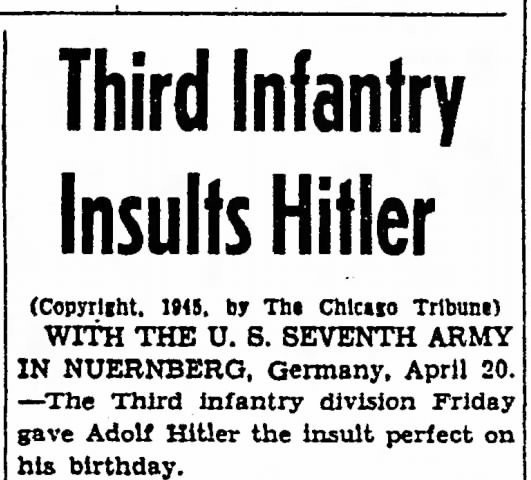


[The Third infantry division] raised the American flag in the Smashed Adolf Hitler platz in the geographical center of Nuernberg, and the division’s band played “The Star Spangled Banner” and “The Dog Faced Soldier” in these precincts where “Deutschland Uber Alles” . . . and the Nazi “Horst Wessel Lied” have resounded in the past.

Daily Oklahoman (Ardmore, Oklahoma), April 21, 1945, page 2.


The nickname was still in use after the war.  The closest near-match to Joe Biden’s “lying dog-faced pony soldier” I could find appeared in an article about U. S. troops training to oppose Communist aggression in Europe during the early-Cold War.  In this instance, however, the expression was not an oxymoron.

They are not pretty, but they make the man who lives and overcomes nature at its worst seem a magnificent creature, rather than a sweat-stained, unwashed, “dog-faced” ground soldier.

The Baltimore Sun, September 9, 1951, Features, Section A, page 1.

The infantry nickname received attention again in 1953 when Major General William F. Dean, who had led a “valiant, last-ditch defense of Taejon – in which he battled personally with a bazooka,” returned home after three years of captivity during the Korean War.  His words upon his return were widely reported.


I want you to get it out of your heads that I’m a hero – I’m not.  I’m just a dog-faced soldier. 

Public Opinion (Chambersburg, Pennsylvania), September 23, 1953.

It was this well-known usage of “dog-face” that likely influenced the narration used in She Wore a Yellow Ribbon, although in the context of a film which took place in 1876, it was an anachronism.


Other Senses of Dog-Faced

Long before the United States Army adopted “Dog-Face” as a self-deprecating nickname, it had a long history as an insult to one’s looks.  It was also used descriptively with a number of unrelated things and people.

Dog-Faced Baboon


George Shaw, Naturalists’s Miscellany,  Volume 6, 1813.


Jo Jo the Dog-Faced Boy

Perhaps the most famous “dog-faced” person was Jo Jo the Dog-faced boy, a Russian who had toured Europe with his father and came to the United States under the auspices of P. T. Barnum following his father’s death.


Years later, a family from Manadalay had a similar skin condition.


Photograph of a Hairy Family of Mandalay.  It is Possible That the “Dog-Faced” Men of the Chinese Wilderness Are the Ancestors of These People.

San Francisco Examiner, June 17, 1923, American Weekly Section, page 9.


This dog-faced potato weighing two pounds, two ounces was brought to the Daily Star offices from the farm of Frank Carlson near Atlas, Wis.  Carlson is a pioneer settler in his district and raises spuds and peas principally but this is the first dog-faced spud he has ever unearthed.

The Minneapolis Star, October 15, 1927, page 12.


[i] Joe Biden speaking at a rally in support of Senator Heidi Heitkamp (D-ND) in Fargo, North Dakota, posted November 1, 2018.  https://www.youtube.com/watch?v=cQFtkEN6Sds
[ii] “Joe Biden Just Called a Woman at One of His Events a ‘Lying, Dog-Faced Pony Soldier.’ What?,” Matthew Dessem, Slate.com, February 9, 2020. https://slate.com/culture/2020/02/joe-biden-dog-faced-pony-soldier-john-wayne-tyrone-power.html 
[iii] The Spokesman-Review (Spokane, Washington), July 10, 2005, page 36.
[iv] The Paris News (Paris, Texas), May 31, 1986, page 1.

Friday, February 7, 2020

Dogs on Public Transportation - a Century of Progress


On February 7, 2020, on a segment of the Fox News show, The Five, Pete Hegseth featured a story about a black Labrador dog in Seattle who occasionally rides on public transit alone to visit the dog park. 

Hegseth was not breaking any new ground.  Versions of the story had been circulating around the internet since at least 2015.  First “discovered” by Seattle radio host Miles Montgomery and reported on KOMO-TV[i], a black Labrador named Eclipse occasionally gets on the bus without her owner, Jeff Young, and rides the bus to the dog park, where Young meets up with her later.   An updated version of the story from the Daily Mail[ii] revealed that Eclipse now leaves home, gets on the bus, visits the dog park, and returns home alone nearly every day.

Nor was Eclipse breaking any new ground in canine public transportation.  Nearly a century earlier, a Fox Terrier named “Spot” famously rode the third-rail electric railroad between East Weymouth, Pemberton, Nantasket and Braintree, Massachusetts, perhaps even eclipsing Eclipse’s accomplishments, leaving a spot on her impressive record.  Spot reportedly followed a regular schedule, hopping on and off trains at various stations, at certain times, timed to meet the regular train schedule. [(For more information on the connection between Boston-area third-rail systems and the idiom, "the third-rail of American politics," see my earlier post, "Rotgut Moonshine, Boston and Politics, a Potent Mix - an Electrifying Etymology of the "Third Rail" of American Politics.")]

Some reports about Spot were “fake news,” so a railroad employee set the record straight in an interview with a reporter from the Boston Globe.


Ever since the broad gauge electric car system was introduced at Nantasket the employes of the road have had a mascot in the form of a little scrubby and tailless dog which they proudly claim belongs to the fox terrier species.  There is little danger of controversy on this point, for even a connoisseur in dog flesh would not attempt to task of denying the purity of his breed in the presence of his admirers.

Although Spot has unquestionable tendencies to vagrancy, he has acquired a widespread reputation for possessing a remarkable intellect which his friends, the conductors and motormen, never tire talking about and praising.

Dogs in many instances have manifested strong propensities for railroading, or rather for traveling, using with undeniable intelligence the steam railroad to this end.

Spot has already acquired considerable newspaper notoriety, but in a rather ambiguous way, so far as facts are concerned, and entirely unsatisfactory to the railroad men, who have made an urgent and unanimous request that a simple and truthful statement of facts be published.

One of the conductors, whose enthusiasm over the sagacity manifested by the dog is moderate compared with that of many others, gives the facts in the case, as follows:

“We want The Globe to give the facts, as the stories that have appeared in other papers have been ‘away off,’” was his preliminary remark.

“Spot, the pet and pride of the railroad men from Braintree to Pemberton,” he continued, “first came to notice in 1892 by falling into the hands of H. F. Bates, railroad agent at East Weymouth, when only four weeks old.  Mr. Bates reared him and taught him many tricks, but three years ago he was obliged to give him away, not having any place to keep him.

“He found a good home with H. L. Hayward at East Weymouth, but continued to be a constant visitor at the depot, and since the advent of the third rail electrics in 1895 has become a regular railroad fiend, and few are the travelers on the road who o not know him.

“A wonderfully sagacious dog,” continued the conductor, growing enthusiastic, “displaying many traits which are almost human.  At first he used to ride on the front end of the cars with the motorman, but one day a sudden stopping of a car pitched him off, and since then no amount of coaxing nor sweet-meats from the motorman’s pail can persuade him to ride on that end of the car.

“Generally he will start out in the morning from East Weymouth and go through to Pemberton, where he will remain the greater part of the day, going the rounds of the railroad boys, and taking a dip in the sea.  Then, again, he will get off at Nantasket, make his rounds there, and take a later train to Pemberton, or go through to Braintree. . . .”

When not riding on the cars Spot rambles about the beach, strictly attending to his own business.  He seemingly knows when trains are due, running north or south, at the different stations.  He seldom loiters about the way stations, having apparently regular times for making his connections.  In this familiarity with the time tables of the road he shows remarkable intelligence and memory, considerably more than many people.


The Boston Globe, September 15, 1898, page 8.


[i] “Black lab rides bus alone to dog park,” USA Today Network, Associated Press, published 10:02 p.m. ET January 13, 2015 (accessed February 7, 2020). https://www.usatoday.com/story/news/nation-now/2015/01/13/black-lab-rides-bus-seattle-washington/21726965/
[ii] “A public transit pub! Meet Seattle dog who takes the bus by HERSELF every day to visit her favorite dog park,” Faith Ridler, DailMail.com, published 12: 16 EST, February 7, 2020. https://www.dailymail.co.uk/femail/article-7937421/Adorable-Seattle-dog-takes-bus-day-visit-favorite-dog-park.html

Tuesday, January 21, 2020

George Van Derbeck and the Early History of Night Baseball

George Van Derbeck founded three baseball teams, each of which introduced a now-familiar team-name into American sports: the Portland Webfooters (1890), a precursor of the Oregon Ducks name now associated with the University of Oregon; the Los Angeles Angels (1892), the first professional league baseball team in Los Angeles, a precursor to today's Los Angeles Angels of Anaheim in the American League; and the Detroit Tigers (1894), who are still in business as the Detroit Tigers of the American League.  

For more background on George Van Derbeck and a history of his three teams and team names, see my earlier post, Angels and Tigers and Ducks - a Baseball Biography of George A. Van Derbeck

Coincidentally, all three of his baseball teams were involved in three of only a hand-full of early experiments in night baseball under the light.

In 1896, Van Derbeck's Detroit Tigers baseball team, then in the Western League, arranged what may be the earliest night game involving a major league team, an end-of-the-season exhibition meeting with the Cincinnati Reds of the National League.[i]  Little is known about what happened at the game, the results were not published and the result of the game was not included in a summary of the four-game series played between the teams that week, in which Detroit bested the National Leaguers three games to one.[ii]

The game is not a major landmark in baseball history.  It did not spark a trend of more night games, it was not the first game ever played under electric lights, and wasn’t even the first George Van Derbeck team to play a night game.

People had been dreaming about playing baseball at night from the moment Edison invented his light bulb.

The New Orleans Picayune has discovered that Edison has not lived in vain – base ball can be played under his light.

The Brenham Weekly Banner (Brenham, Texas), December 27 1878.

The night may not be distant when a nine inning base ball game will be played under its rays.

Little Falls Transcript (Little Falls, Minnesota), August 7, 1879, page 1 (reprint of New York Sun article).

Children in New York City’s City Hall Park played “tag and leap frog” under the “vivid rays” of an electric light mounted on the New York Sun Building in 1879, prompting one observer to imagine that, “the night may not be distant when a nine inning base ball game will be played under” electric light. [iii]  Any children who might have played baseball under that same light would have been among the first people anywhere to play a night game of baseball under the lights. [iv]

Employees of two Boston mail-order retailers, R. H. White & Co. and Jordan, March & Co., played what is believed to be the first game of night baseball at the Sea Foam House in Hull, Massachusetts on September 2, 1880. [v] 

The National League’s Indianapolis team scheduled a night game against Fort Wayne of the Northwestern League in 1883, which would have been the first all-professional night game if it had actually taken place.  The game was initially postponed due to weather, and later cancelled after an exhibition game on the same field, between a minor-league team from Quincy, Illinois and a college team from Fort Wayne, demonstrated the inadequacy of the light for satisfactory fielding.[vi] 

In 1888, Indianapolis and Detroit scheduled what would have been the night game between two major league teams, this time under gaslight instead of electric lights.  Tests with two lights seemed promising, but when they added more lights, the light from each became dimmer.  The team owner eventually scrapped the idea.[vii]

In 1890, Hartford hosted Baltimore in a nighttime exhibition game played under eight arc lights one evening after a regular-season, Atlantic Association matchup.[viii]  To lessen the dangers of playing in relative darkness they played with a softened ball and pitched under-handed.  The game lasted only a few innings.

The Electric Light Picnic.

Twenty-five hundred persons gathered at the ball grounds tonight, expecting to see a base-ball game by electric light. The game was a farce.  Only a few innings were played, and nobody knows the score, although Hartford is believed to have won.  Score cards were sold, but they could not be used, as, in the absence of a sufficient number of policemen, the crowd rushed upon the field.  Eight arc lights were used – three at first base, three near third, two in centre field and one on the grand-stand, but the number proved inadequate.  A twenty-cent ball was used, and it was softened by being pounded with the bat.  Daniels and Valentine tried to do the umpiring.  Kid and O-Rourke were the pitchers and tossed the ball to the batter in the old-fashioned style.

The Baltimore Sun, July 24, 1890, page 6.

With night games so few and far between at the time, it is interesting to note that the Detroit Tigers were not George Van Derbeck’s first team to play at night; they were his third team to experience night baseball. 

George Van Derbeck brought professional baseball to Portland, Oregon with his first professional baseball team, the Portland Webfooters (the team’s nickname a precursor to the now-well known Oregon Ducks).[ix]  In August of 1891, the Webfooters played a three-inning, nighttime exhibition game at Spokane following an official Northwestern League matchup in the afternoon. 

A NIGHT OF SPORT
Baseball by Electric Light Next Sunday Evening.

Next Sunday evening a unique entertainment will be given at the ball park at Twickenham under the auspices of the Spokane Athletic Club.  Fifty arc lights will be placed on the grounds, and a game of ball will be played between the Spokane and Portland teams.  Each player will appear in a grotesquely ridiculous suit of his own selection, and a prize will be given to the player appearing in the funniest make-up. 

The Spokane Review, August 2, 1891, page 8.


Spokane Chronicle, August 8, 1891, page 5.

The Webfooters took the daytime game by a score of 8-6[x] and prevailed in the abbreviated night game 4-3.

SPORT BY ELECTRIC LIGHT.
A Large Attendance and Interesting Contests Indulged In.

Spokane, Aug. 9. – [Special.] – Five thousand people saw the ball game and other sports by electric light tonight. The ball grounds were brilliantly illuminated by seventy-five arc lights.  Three innings were played, Portland winning by 4 to 3.  The Spokane players wore ridiculous costumes.  Manager Barnes was umpire, and enforced his decisions with a revolver and blank cartridges.  Tom Parrott won the 100-yard dash, with Stenzel second.  Parrott also won the ball for throwing a distance of 370 feet.  Flaherty was second, 363 feet.  Other events made up a ninteresting programme, and the novelty of the sports by electric light was an unqualified success.

Seattle Post-Intelligencer, August 10, 1891, page 3.

Van Derbeck founded his second team in Los Angeles in 1892.  In 1893, his team, the original Los Angeles Angels (a century before they were “of Anaheim”), staged a “Burlesque” game of night baseball before a capacity crowd following an official, California League day-game against Stockton.  Van Derbeck himself had been forced out of the league before the start of the season, so he was not personally involved in the game.  He moved to Detroit to start the Tigers before the end of the year.[xi]

The Angels took the day-game by a score of 7-3.  The home team was also won the nightcap 5-2, but the score was meaningless in a game played entirely for comedic effect.  The game featured a bulldog, an Angel dressed as the Devil, reverse base-running, and a potato race.


Some twenty arc lights were hung over the diamond, and a search light was manipulated from over the grand stand so as to strike any desired spot on the grounds.

Soon after 8 o’clock there was music by the band, and the procession approached the diamond.  Manager Lindley came first, wearing a hat nearly as tall as himself, and trailing behind were the respective members of the two teams accompanied by the musicians.

The costumes were of variegated colors and of fantastic designs, and their appearance provoked roars of merriment.  One of the Angels, sad to relate, had temporarily so far fallen from grace as to appear like a certain character whose raiment is of red and whose feet are cloven.

After marching two or three times around the grounds there was a neat little introductory speech by Manager Lindley, after which the players took their positions.  Umpire Brink stood just behind the pitcher and held a rope in his hand.  There was a bull dog on the other end of the rope.

The various players then took turns in going to bat.  Some of didn’t go to bat, but used an old broom or umbrella instead.  It was a play-as-you-please game, and they were not over particular about the rules.  One of the batters even ran to third base instead of to first.  Hits became fouls and fouls were decided to be strikes, which caused the crowd to yell.  This nettled the bull dog, and he caught a fly on his own account.

A committee was appointed to get the ball again without getting a bit, and, after this had been done, there was some more sorrowful batting.  Sometimes the ball would drop to the ground close to the batter, and he would make a home run before the sphere was picked up.  There was more agony drawn out to some length, during which the bull dog got weary and was retired from the field.

The game was finally awarded to the home team by a score of 5 to 2, and then the Angels with one fell swoop of their wings polished the Stockton chaps off the diamond.

A song rendered by “Buck” Hughes was liberally encored, and a potato race by four nimble colored individuals concluded the evening’s entertainment.

The Los Angeles Times, July 3, 1893, page 2.


[i] For more information, see,“The First Night Game at Michigan & Trumbull was Played in 1896,” Richard Bak, VintageDetroit.com, August 31, 2011. https://www.vintagedetroit.com/blog/2011/08/31/the-first-night-game-at-michigan-trumbull-was-played-in-1896/
[iii] Little Falls Transcript (Little Falls, Minnesota), August 7, 1879, page 1 (reprinted from the New York Sun.).
[viii] “Night Baseball in the 19th Century,” Eric Miklich, 19cbaseball.com. http://www.19cbaseball.com/field-10.html
[x] Seattle Post-Intelligencer, August 10, 1891, page 3.