The American song, “Ninety nine Bottles of Beer on the Wall,” dates to at least 1945. The British, children’s counting song, “Ten Green Bottles Hanging on the Wall,”
dates to at least 1933. The origins of these songs are not well known, although several sources assume that the American version is a later variant of the earlier, “traditional” English version. An April Fool’s
hoax published in 1999 muddied the waters, providing two fake histories, suggesting origins in England in either the 1830s or the fourteenth century.i
Actual evidence, however, suggests both songs have roots in the Midwestern and western United States. The earliest known reference appeared at the University of Minnesota in 1883, with
additional references in California (1884), North Dakota (1884) , Kansas (1885), Missouri (1887), Michigan (1885) and Nebraska (1889) before the end of the decade.
Lyrics to various early versions of the song generally describe the bottles as blue or green in color, always describe them as “hanging on the wall” (as opposed to simply “on
the wall), and start the countdown from ninety-nine or forty-nine.
The earliest British reference to something similar appeared in 1929, with “Three Bottles Hanging on the Wall,” first described as a “traditional bowling ditty.”
The earliest reference to the now-familiar, “Ten Green Bottles Hanging on the Wall,” appeared in 1933, in an account of a radio broadcast about traditional Yorkshire songs, which may account for the belief that
the song originated there.
For jollity and spirit one might select from among others the simple and cheerful song “There be ten green bottles hanging on the wall.” It goes with vigour, and after ten verses
there are no more bottles left.
The Manchester Guardian, March 14, 1933, page 10.
Early musical notation for the original, American “Blue Bottle” version suggests its melody is similar to the modern, British “Green Bottle” version. The now-traditional
American version, however, has a different tune and “bottles of beer on the wall,” as opposed to colored bottles “hanging on the wall.” It first appeared in print in the mid-1940s.
Given the timeline of when and where early references to one or the other of the songs appeared, it seems reasonable to conclude that both the modern American and British versions of the
song ultimately of American origin, both based on the original, American “blue Bottle hanging on the wall” version.
Unanswered questions remain. Why were the bottles described as “hanging on the wall,” and what is the significance of the blue (or green) bottles? Period references to “blue
bottles” hanging on walls suggest two plausible, albeit unlikely, explanations - flies or fire extinguishers.
“Blue-bottles” was once a common expression used to refer to certain, large house flies. Was the original lyric about flicking ninety-nine flies off the wall?
 |
Arapahoe Pioneer (Arapahoe, Nebraska), December 16, 1881, page 2. |
And beginning in about 1884, blue (sometimes green) bottles, filled with supposedly fire-suppressing chemicals, were widely and aggressively marketed and sold as “hand grenade fire
extinguishers.” The bottles were frequently hung on walls, for ready use in an emergency.
Manual of the Panorama of the Battle of Shiloh, Michigan Avenue, between Madison and Monroe Streets, Chicago, A. T. Andreas, 1885.
Two blue bottles, called hand grenades, were hung up by wires around the necks against the wall.
The Cedar Rapids Gazette (Iowa), May 28, 1884, page 3.
Our blaze was quickly subdued by the aid
Of what is known as the Harden Hand Grenade -
Those bottles you see hanging there on the wall;
And of fires since this test I’m no longer at all
Apprehensive.
The Sad Fate of Niagara Number One, New York, J. C. Rankin, 1885.
There are still some thousands of these blue bottles hanging on the walls of buildings, but good time will very often be wasted in attempting to do anything with them.
“Modern Fire-Extinguishing Appliances,” G. W. Melvin, The Surveyor, April 27, 1893, page 266.
The timing, ubiquity, colors and frequent hanging of the bottles on walls are all consistent with such colored bottles being related to the origins of the song. I have not uncovered any
smoking gun that unambiguously connects either one of these theories to the song, however.
You be the judge.
NOTE: Since publishing this post, I was made aware of a reference suggesting the song was actually about the hand grenades. Further digging on my part found an earlier version of the song that was about blue-bottle flies. Apparently both speculations may have been true. See my update, Birds, Bottles and Flies, the Early History of "Ninety-Nine Bottles of Beer on the Wall." Continue reading here for a detailed discussion of the later history and development of the song, blue-bottle flies and blue bottle, glass hand grenades.
99/49 Blue/Green Bottles Hanging on the Wall
The University of Minnesota Class of 1886 are the first people known to have sung a bottle-countdown song, during their “leap year dash” in early 1884.
But the greatest of all events [during our sophomore year] was the leap year dash - four horses, a coach, driver, footman, the Sophomore class, a handsome reception by Miss Sewall, games,
songs, “Ninety-nine Blue Bottles Hanging on the Wall,” home before anyone is up, and all the invention and management of the girls. The boys would like to leap every year.
“History of ’86. . . Sophomore Year,” Keys Makhlout, Volume I, 1883-1884, Published by the Junior Class, University of Minnesota, Tribune Job Printing Co., 1884.
The song may not have originated there, but it does not appear to be much older. I have been unable to find a single reference to anything like the song earlier than 1884, and several references
to the song appear during that year, suggesting that it was relatively novel.
An apparent reference to the song appeared in California on February 9, 1884.
A very pleasant entertainment and “Welch Rarebit” party was given Friday evening by Mr. and Mrs. Fillmore at their rooms at the Cosmopolitan in honor of their visitors, Mr. and
Mrs. Ivenson of Laramie, and “Fluke McGlyn was there with but one more river for to crossii, and forty bottles hanging on the wall.”
Daily Evening Tribune (San Luis Obispo, California), February 9, 1884, page 3.
The song was in North Dakota in November 1884, with the number of bottles set at forty-nine.
This amusement and hilarity begun to subside about half past two when some evil spirit took possession of McMillan who sprung that interminable song “Forty-nine blue bottles hanging
on the wall,” which contains forty-nine verses all alike with the exception of dropping down one bottle in each verse.
Jamestown Weekly Alert (North Dakota), November 27, 1884, page 4.
The song was in Kansas in 1885, but apparently not appreciated.
The outfit of bards who sang “Forty-nine blue bottles hanging on the wall,” Wednesday night, ought to “go on the road.”
Barber County Index (Medicine Lodge, Kansas), July 24, 1885, page 3.
The song was known in Upstate New York later the same year.
We enlivened the time by playing wagon games or singing every song we knew, from “Ninety-nine Blue Bottles A-hanging on the Wall” to “Oh, Why Did They Dig My Grave so Deep?”
till at last we were exhausted, and I fell to thinking of that wonderful view from Mt. Jo, that will always be the most beautiful memory of my pleasant trip to Adirondack Lodge [Keene Valley, New York].
Detroit Free Press (Detroit, Michigan), October 4, 1885, page 2.
A book published in 1890 also suggests the song was sung in the Adirondacks. This the earliest example I could find of the extended lyrics, beyond the title and general description of the
song. It started at an unconventional “ninety-eight bottles.”
“Now warble your wildest.”
“Let’s give him - ‘Ninety-eight blue bottles were hanging on the wall,’” cried Travers.
Yes - yes! Ninety-eight blue bottles were hanging on the wall. Take one blue bottle away from them all, and ninety-seven blue bottles are hanging on the wall.”
It seemed to Uncle Joseph as if that song just be heard back on Racquette Lake by the prodigious noise it made.
“It’s worse than the loons,” he exclaimed, with a shiver.
“Next verse,” cried Travers, as leader.
“Ninety-seven blue bottles are hanging on the wall. Ninety-seven blue bottles are hanging on the wall. Take one blue bottle away from them all, and ninety-six blue bottles are hanging
on the wall.”
“Next verse. Ninety-six blue bottles are hanging on the wall. Ninety-six blue bottles are hanging on the wall. Take one blue bottle away from them all, and ninety-five blue bottles
are hanging on the wall.”
Margaret Sidney, An Adirondack Cabin; a family storytelling of journeyings by lake and mountain, and idyllic days in the heart of the wilderness, Boston, D. Lothrop Company, 1890.
The earliest example of “green bottles” (which would later become standard in England) appeared in Nebraska in 1889, in an account of the performance of the “female minstrel
orchestra” comprising congregants of an Episcopal church.
The first rendition was an overture, produced on every imaginable instrument in every known key and in an enthusiastic manner and the professor perspired until his beard faded away before
he finally persuaded them that the police had been sent for to quell a riot.
After this followed songs, duets and recitations by the individual females closing with the Italian opera, “99 Green Bottles Hanging on the Wall.” This was the climax, and before
the sixtieth bottle had been “sung from the wall,” the exhausted members of the troupe fainted away, one by one, until only Mrs. Powell and the professor remained seeming determined to get the last bottle off.
Falls City Daily News (Nebraska), May 24, 1889, page 1.
The song appeared in more college publications beginning in 1890, including this early notation of the melody, from DePauw University in Indiana, which appears similar to the modern British
“Ten Green Bottles” version.
 |
Songs of DePauw, Boston, J. M. Russell, 1890. |
The following year, in Amherst, Massachusetts, students at a “mock town meeting” addressed a proposed mock ordinance to decorate “all electric light wires within town limits
with bottles, irrespective of size, color, or previous contents or condition of service.” During “debate” on the issue, they sang the song with appropriate modifications to the lyrics.
Article 2 was taken up. . . . The parson was supported by Mr. Boardman of Pelham, and was found to have carried his side, when those in favor sang, “Forty-nine bottles hanging on the
wire,” opposed by the minority who filled the air with “My comrades when I’m no more drinking.” Disorder arose here, but was quelled by means of the Moderator’s heavy gavel, assisted by the copious
majesty of the law, embodied in Policeman Jacobs.
The Amherst Student, Volume 24, Number 27, May 9, 1891, page 214.
They were singing the song at the University of Texas in 1895 or 1896, as recalled two decades later.
It reminded me of Mrs. Robertson and the gang that boarded with her in 1895-1896. . . . One day I was installed as the favored visitor for lunch and the boys proceeded to render a very select
program as an afternoon concert. To the best of my recollection each number on the program was a ditty, that went something like this:
One hundred blue bottles hanging on the wall
Take one off and ninety-nine was all.
Ninety-nine blue bottles hanging on the wall.
Take one off and ninety-eight was all.
The Alcalde (alumni magazine of the University of Texas), Volume 4, Number 3, January 1916, page 296.
A snippet of the song appeared in a medley in the Wesleyan Song Book, published by Wesleyan University.
 |
The Wesleyan Song Book, Middletown, Connecticut, Wesleyan University Musical Association, 1901, page 76. |
In 1900, a student at Western Reserve University described the song as an “old college song used by some boys when serenading.”iii
A short story in the literary magazine, The Smart Set, featured a college professor using the song to lull his baby to sleep, while his wife is away helping her friend deal with her friend’s new baby. The story, published in 1905, referred to the song as a
“relic” of the professor’s college days.
It was a relic of his college days; he recalled that as a freshman he had been taught to sing it, standing on one foot, by some visiting, though uninvited, sophomores. Professor Tompkins’s
colleagues might have been shocked had they heard him gravely announce:
“Forty-nine blue bottles were hanging on the wall,
Forty-nine blue bottles were hanging on the wall.
Take one blue bottle down
From off the oaken wall,
And there are forty-eight blue bottles a-hanging on the wall.”
The second stanza recognizes the existence of only forty-eight blue bottles, which in the last line are reduced to forty-seven.
“The Professor and the Burglar,” Harry Arthur Thompson, The Smart Set, Volume 16, Number 2, June 1905, page 113.
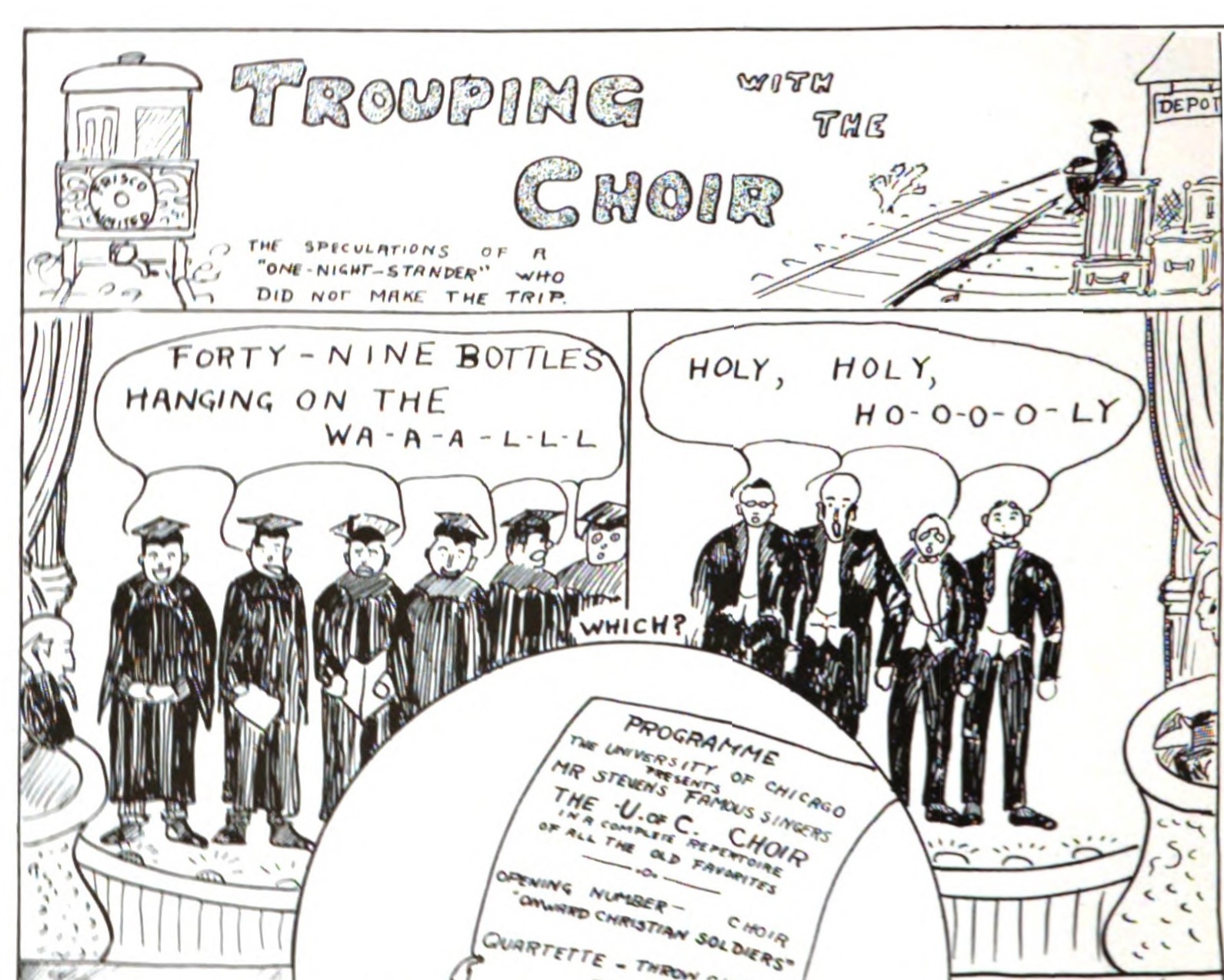
A cartoon in the University of Chicago yearbook, Cap and Gown (1915), portrayed the University of Chicago choir singing “Forty-Nine Bottles” (no color) on its concert tour.
 |
Cap and Gown (University of Chicago yearbook), Volume 20, 1915, page 538. |
The song appears to have been relatively popular among college students, generally. The song appeared in a collection of college songs in 1906, without a designated color and starting with
forty-nine.
The Most Popular College Songs, revised edition, New York, Hinds, Noble & Eldredge, 1906, page 37.
In 1916, Horace Greeley’s granddaughter, Nixola Greeley-Smith (who was touted as the “Greatest American woman reporter during her career as a journalist), described the song
as a “college chant.” She used it in trying to lull a baby to sleep when babysitting. The bottles were green and the countdown began at ninety-eight.
“She needs constant repetition of the same sound to maker her sleep.”
And I racked my tortured brain for some long winded tale in which the same sound would be reiterated over and over. All I could think of was a college chant I had heard from one of my cousins
beginning, “Ninety-eight green bottles of beer were hanging on the wall.” Each verse, you know, recounts the loss of one green bottle and tells how many bottles were left. For about six verses the bottle chant
made a great hit.
At the tenth green bottle the little girl grew restless, at the fifteenth she was bored, at the twentieth she was angry, at the twenty-fifth she was screaming with rage. But such was my faith
in the power of monotony that I kept right on till she was nearly in hysterics.
The Evening World (New York), February 17, 1916, page 14.
An abbreviated version of the song appeared in the Boy Scout Song Book in 1920.
Forty-nine bottles hanging on the wall,
Take one away from them all.
Forty-eight bottles hanging on the wall,
Forty-eight bottles hanging on the wall, Etc.
The Boy Scout Song Book, Boston, C. C. Birchard & Company, 1920.
The earliest example of “beer bottles” (as opposed to blue or green bottles) hanging on the wall came out the unlikely location of Nicaragua in 1895. The song was new to the
writer, but one of his acquaintances described it as “old” and widespread throughout the United States.
About eleven o’clock that night seven or eight jolly young Americans reinforced by not less than forty natives and donkeys planted themselves in front of the hotel and struck up a doggerel
that was new to me but Drew has crossed the United States 26 times and he says the thing is old and has been chanted from Seattle to Portland, or as McKenzie put it in his speech last convention that nominated President Cleveland,
“from Androscoggin to Yuba Dam.” I heard so much of it - they were at it an hour and a half - that I know it by heart.
“There were ninety-nine beer bottles hanging on the wall,
Ninety-nine beer bottles county them all,
Take one of those beer bottles down from the wall,
Leaves ninety-eight beer bottles hanging on the wall.”
The second verse is just like the first except that it commences with 98 and winds up with 97 bottles. This is kept up until there is but one bottle “hanging on the wall” when
the crowd if it feels just right and if it doesn’t rain too much and if the refreshments hang out will run it back to 99 and so on ad infinitum. For a sick man my first Fourth of July in Nicaragua was “tolerably agreeable.” Thomas O’Hara.
Herald-Palladium (Benton Harbor, Michigan), August 29, 1895, page 3.
In 1902, two cadet soldiers of the Forty-seventh Regiment Cadet Battalion of Brooklyn, New York sang the song during their summer camp. They had been missing and feared drowned, after going
out in a rowboat, which turned out to be an unseaworthy “tub.” The search party was out looking for them when they heard a song in the darkness.
Then through the darkness I heard a youthful voice piping out:
“Ninety-eight green bottles a-hanging on the wall;
Ninety-eight green bottles a-hanging on the wall;
Now one of these green bottles it had an awful fall.
that left ninety-seven green bottles a-hanging on the wall.”
The Brooklyn Citizen, July 27, 1902, page 17.
British “Bottles Hanging”
The earliest example of the song from a British source also involved soldiers. The song appeared in a collection of songs, rhymes and parodies sung, recited or told by British soldiers
during World War I. The bottles are not given a color. The accompanying music appears to be different from the Wesleyan Song Book, perhaps closer to the modern, American version of the song.
 |
Tommy's Tunes, London, Erskine MacDonald, Ltd., 1917, page 89.
|
The British soldiers may have learned the song from American soldiers. G. Stanley Hall, a professor of psychology at Clark University in Worcester, Massachusetts, described American soldiers singing the
song during World War I.
Americans tend to hide their real feelings, but their love of jocularity and extravaganzas cannot resist the catchy lilt of such chanteys as Long Boy. Idiotic jingles, and sometimes endless
rhymes like Ninety-Nine Bottles Hanging on a Wall may make them forget fatigue near the end of a long march.
“Morale in War and After,” G. Stanley Hall, Psychological Bulletin, Volume 15, Number 11, November, 1918, page 402.
Music from an American source during the same period appears to be nearly identical to the tune as now-traditionally sung in England. This version has no designated colors for the bottles,
and starts at forty-nine.
 |
American Home Music Album, New York, D. Appleton and Company, 1915, page 913. |
The earliest British reference with “green bottles” appeared in 1929, but with the number apparently starting with three, and described as a bowling (“bowls” or lawn
bowling) song.
At the close all bowlers present united in singing “Three green bottles hanging on the wall” - the traditional bowling ditty.
Acton Gazette and West London Post, December 6, 1929, page 9.
Four years later, an account of a radio show about supposedly traditional Yorkshire folk songs mentioned, for the first time in print (as far as I have found), the now-traditional “Ten
Green Bottles” song. The show was moderated by Wyndham Goodden, based on notes by Beatrice Tunstall.
North Regional listeners hears last night a continuation of the series of “Folk-songs of the North,” with Yorkshire songs by the Sheffield Orpheus Male Choir. Miss Beatrice Tunstall
had collected the notes for the songs, and Mr. Wyndham Goodden presented them with a commentary which was not only an explanation but was entertaining in itself, for it ranged over interesting points apart from those illustrated
by the songs. . . .
For jollity and spirit one might select from among others the simple and cheerful song “There be ten green bottles hanging on the wall.” It goes with vigour, and after ten verses
there are no more bottles left. These folk-songs made an extremely good programme; they are well arranged, introduced with natural interest, and excellently sung.
The Manchester Guardian, March 14, 1933, page 10.
Beatrice Tunstall was born in Lancashire and grew up and lived most of her life in Cheshire. She was considered to have a “vast store of knowledge of Cheshire, its traditions and
legends, its family, histories and folkways. She was not known as an expert on Yorkshire. Wyndham Goodden produced radio dramas for the North Regional Station of the BBC. He resigned his position in August 1933 to join
the staff of the Bedford School as its “arts master.”
Their presentation of Yorkshire folk songs was one of a series of local history dramas, which he described as “radioramas” (radio panoramas), intended to “present by sound
pictures and dramatic episodes a broad description . . . of the history of different cities of the North Country,” including Carlisle, Chester and York.iv
Tunstall and Goodden may have believed that the song’s origin was in Yorkshire, and it is possible that the song had been sung there for decades. Five decades had elapsed the song
had first appeared in California, Minnesota and North Dakota. Given the absence of evidence of earlier appearances in England, and the large number of American references before the earliest British examples, the claim that
“ten green bottles” is older than the American “Ninety-nine (or forty-nine) Blue Bottles, in retrospect, seems to have been made in error.
“Bottles of Beer on the Wall”
The modern British version of the song, “Ten Green Bottles,” may be older than the now-familiar American version, “Ninety-nine Bottles of Beer on the Wall” (with
bottles “on the wall” as opposed to “hanging on the wall”). The earliest examples of the modern American version appeared in the 1940s. The earliest examples I have found were all from high school.
We heard the Greenfield pep squad again singing the “Bottles of Beer on the Wall” song on the bus Friday night, and this time they left “no bottles of beer on the wall.”
It all goes to show something or other.
The Greenfield Vidette (Greenfield, Missouri), February 22, 1945, page 2.
The G. A. A. hayrack ride last Saturday held excitement galore for the twenty-odd members that challenged the cold weather. Beside the five mile ride, and the weiner roast afterward, several
black snakes livened the party. Songs that were sung ranged from “Forty-nine Bottles of Beer on the Wall,” to “Brahm’s Lullaby.”
Central High Register (Omaha, Nebraska), November 9, 1945, page 4.
The School News segment in a local newspaper printed several “theme songs” associated with particular people in the
class, including one apparently for C. Staiger, the music editor of the School News.
Theme Songs . . .
7. 99 Bottles of Beer on the Wall - Wacky Staiger.
The Potter Enterprise (Coudersport, Pennsylvania), May 20, 1948, page 6.
The Boys Club of Bedford, Indiana sang the song during a field trip to Cincinnati to see a Cincinnati Reds baseball game.
They sang everything from the Lord’s Prayer to Ninety-Nine Bottles of Beer on the Wall. They may not be as good as Frank Sinatra but they are a lot louder.
The Times-Mail (Bedford, Indiana), August 26, 1948.
The Boy Scouts of Mt. Pleasant, Utah sang the song during a trip to Canada. This is the first example I have found that includes the words to the entire verse, identical to the now-traditional
version.
About now a song was started that goes about so: 99 bottles of beer on the wall, 99 bottles of beer, you take one down and pass it around, 98 bottles of beer. This goes all the way down to
1 bottle of beer.
The Pyramid (Mount Pleasant, Utah), August 26, 1949, page 4.
The modern British version of the song, “Ten Green Bottles,” may be older than the modern American version of the song, “Ninety-Nine Bottles of Beer on the Wall,”
but they both appear to have been derived from an earlier American version, with ninety-nine or forty-nine blue or green bottles “hanging” on a wall.
Fake News
On April 1, 1999, Brian Hunt (if that’s his real name) published a fake history of the Ten Green Bottles song. Frustratingly, for someone trying to pin down the history of the songs, several sources have regurgitated the fake history as fact. This is similar to the
widespread circulation of the fake history of the kazoo, which was actually created by a kazoo comedy troupe in the 1970s (yes, there was such a thing). Read more about that on my post, “Bazoo, Kazoo, Bazooka - from Playful Instrument to Instrument of War.”
The fake bottle-song history centered on a “fiercely intense debate about the nature of scholarship, sparked by the discovery of a fragment of English folk song”; debates reminiscent
of those surrounding the “Findelmaier Proposition” in the Ryan O’Neil and Barbra Streisand comedy classic, What’s Up Doc!
A French scholar named “Pierre d’Ouidlede,” had supposedly discovered a fragment of a page of 14th century manuscript, revealing one verse of a poem:
Syxthene boetell gryne Yhangen,
Yhangen, Yhangen, Yhangen,
Syxthene boetell gryne;
Doonfal won,
Syxthene boetell gryne Yhangen,
Yhangen An . . . .
National Post (Toronto, Canada), April 1, 1999, page 25.
A Professor “Muddlewheat” from England supposedly latched onto the fragment as “proof” that the “green bottle” song was centuries old. Based on the random
number in the fragment, he postulated that there must be other verses and that it had to be a precursor of Ten Green Bottles.
A supposed “freelance musicologist and philosopher” named Brett Shatner disagreed. He was said to have written that it was a “profound shock to see the depths to which British scholarship
seems to have sunk. If it is ‘obvious’ to Prof. Muddelwheat that verses exist for which there is no material evidence, then he should perhaps change his professional title to ‘clairvoyant’ rather than
‘musicologist.’”
Weeks later, yet another voice chimed in, when a “Mr. E. C. Poswaithe” claimed to have done “extensive research” into the song in the 1950s, and had “proved
to his own satisfaction that the song originated in the London underworld of the 1830s.”
Frustrating attempts to get to the bottom of the issue, Professor Shatner had supposedly vanished without a trace.
Nothing in the article makes much sense. The professors do not exist, their named schools do not exist, and even after one “boetell gryne” “doonfal won,” there are
still “syxthene boetell” left - so even the fake premise of the fake article makes no sense. But although many details of the article are patently absurd, Mr. Poswaithe’s supposed comments raise one important point - “Poswaith’s Postulate,” if you
will.
If these are glass bottles, why should they be ‘hanging’ rather than ‘standing’ on a wall - the latter situation would not only be more logical but more likely to precipitate
the destructive series of tumbles the song catalogues incrementally.
National Post (Toronto, Canada), April 1, 1999, page 25.
“Blue Bottles Hanging on the Wall”
In the earliest known version of the song and in most of the early references to the song in print, the bottles were “blue bottles.” Which raises the question, what is a “blue
bottle”? Scouring digitally searchable archives from the period in which the first examples of the song appear, and the few years prior, unearthed two likely candidates.
By far the most common reference to “blue bottles” is not a reference to a bottle at all - but to a type of fly. A second possibility is a type of fire extinguishing “hand
grenade,” aggressively marketed and sold beginning in about 1884, the same year in which the song first appeared. The “grenades” were pint-sized blue or green glass bottles which were frequently hung on
walls.
Blue Bottle Flies
In Praise of the Blue-Bottle. - An animal is wanted for the special purpose of destroying carrion, so as to prevent it becoming a nuisance. The creature appropriate for this purpose is a
small worm, known as a maggot. But how are such worms to be extemporized, when a mass of putrid meat is to be disposed of?
The difficulty is beautifully got over by sending a particular kind of big fly called a blue-bottle, that is entitled to rank as a scavenger-general.
The New York Times, May 11, 1879, page 4 (reprint from Chambers’s Journal).
Blue Bottle’s Revenge.
Down on the floor, on the other side of the big table, were two boys fighting . . . .
Yes, they were, as true as anything, spending the time that beautiful bright day in squabbling and screaming till the humming and buzzing of a hundred blue bottles couldn’t have been
heard.
The Clay Center Dispatch (Kansas), December 2, 1880, page 3 (reprint from Youth’s Companion).
Gentle Jane was good as gold;
She always did as she was told;
She never spoke when her mouth was full,
Or caught blue-bottles their legs to pull . . . .
Gilbert & Sullivan, Act 2, Scene One, Patience or Bunthorne’s Bride (1881).
THE BLUE-BOTTLE FLY
Buzzing and gay in the early dawn,
Fresh from a nap on the parlour wall,
Out for a flight over garden and lawn,
Fearing no tumble and dreading no fall,
Came a fly:
A lively, frolicsom, blue-bottle fly. . . .
The Leeds Mercury (Yorkshire, England), November 5, 1881, page 18 (widely reprinted in the United States; for example, Detroit Free Press, November 9, 1881, page 3; Arapahoe Pioneer (Nebraska), December 16, 1881, page 2; Pomona Times, October 7, 1882, page 1).
A Novel Sport.
A letter to the New York Sun brings some singular intelligence as to the character of the newest entertainments of a sporting kind
pursued by the English during the Lenten season. Pigeon-shooting was first the rage, but the Princess of Wales lifted up her voice against the cruel sport and stopped it. As there was nothing else that could be killed out
of doors the manly sportsmen of both sexes thereupon contrived some indoor shooting, which is thus described by the Sun’s correspondent:
“Instead of pigeon-shooting we inaugurate insect-shooting. Bumble-bees par excellence, then blue-bottles, cockchafers - any small, fat, flying thing in season - is game. A gallery
is erected. The victims are boxed up, let loose, and fired at by miniature guns and rifles of exquisit workmanship.”
Chicago Tribune, February 25, 1883, page 4.
If “blue bottles” did refer to flies in the original lyrics, it would explain both why the bottles were blue, and why they could be “hanging on the wall.” It seems plausible that the count-down
of “blue bottles hanging on the wall” could refer to the systematic removal of flies hanging on the wall, but we may never know.
Blue Bottle Hand Grenades
In 1871, a man named Samuel B. Johnson patented an “improvement in fire-extinguishers,” which he described as being “in the form of a grenade or bomb, and constructed of
glass, that it can be easily thrown or discharged, and break when it strikes the spot against or toward which it is directed.” US Patent 117,891 (August 8, 1871). The patent was later assigned to a man named P. J.
Clark, who granted two licenses; one to the Harden company and one to Hayward.
Two people apparently associated with one of the licensees, John J. Harden and Henry D. Harden, later received additional patents for improvements in the hand grenade, US Patents 282,981
(August 14, 1883) and 306,154 (October 7, 1884).
In October of 1882, the Harden’s staged what may have been their first, of many, public tests of the supposed fire-extinguishing capabilities of their “hand grenades.”
The Chicago Inter-Ocean, October 4, 1882, page 8.
Several months later, they were recruiting sales agents for Missouri and Kansas.
St. Louis Post-Dispatch, February 2, 1883, page 6.
In August of that year, the Hardens reorganized their business.
NEW CORPORATIONS.
. . .
The Harden Hand Grenade Fire Extinguisher company, of Chicago: capital stock $100,000; incorporators, John J. Harden, Henry J. Mellen and Charles E. Kruger.
The Rock Island Argus (Rock Island, Illinois), August 24, 1883, page 4.
The new company registered the shape and color of their bottles as trademarks (11,883, December 29, 1884), describing them as “a blue or bluish green grenade bottle having a general
configuration or appearance of a melon with the meridian like flutings and an equatorial band and having a red label upon and about the base of the bottle neck.”
The Harden hand Grenade Fire Extinguisher consists of glass globe, filled with a chemical fluid, highly charged with, and generating in fire a gas in which it is impossible for combustion
to continue.
Daily City News (New Castle, Pennsylvania), December 5, 1883, page 3.
References to the grenades in print referred to them variously as “blue bottles” or “green bottles,” although the color blue appears to predominate when a color is
specified.
They were “green” in a description of one of their public demonstrations.
The Harden Hand-Grenade.
An experiment was made this afternoon, pursuant to announcement, on Washington Square, with what is known as the Harden Hand-Grenade Fire Extinguisher. . . . [W]hen the flames had got a fair
hold on the wooden structure, about 10 feet in height, and were flashing above the uppermost boards, an experimenter advanced within a few feet of the flames, having in his hand apparently a globular green glass bottle, about
six inches in diameter, with a tightly sealed neck about three inches in length. This he held between him and the fire and struck with a hammer, which exploded the bottle and reduced the flames rapidly.
Deseret News (Salt Lake City, Utah), April 2, 1884, page 2.
Following a demonstration in Iowa the following month, the bottles were “blue” and hung against a wall, where it apparently acted automatically in response to the heat of the
fire, like a proto-sprinkler system. A witness sang its praises, almost as though it were Brother Maynard’s “Holy Hand Grenade of Antioch.”
Two blue bottles, called hand grenades, were hung up by wires around the necks against the wall. The match was applied and oil thrown on the fire and when the mass was burning freely the
bottles burst, and as if by magic the fire which a moment before threatened sure destruction to the structure, was so effectually and thoroughly etinguished as to call forth the praise of all for the wonderful hand grenade.
The Cedar Rapids Gazette (Iowa), May 28, 1884, page 3.
These and other tests around the United States and Canada were happening at about the same time the University of Minnesota sophomores sang the song during their “Leap Year dash”
in early-1884.
The manufacturers, merchants and property owners of Dayton, are respectfully requested to witness an exhibition test of the Harden Hand Grenade Fire Extinguisher, better known as those “Little
Blue Bottles,” which will be given to-morrow . . . .
The Dayton Herald (Dayton, Ohio), June 10, 1884, page 3.
A second trial of the harden Hand grenades was made on the parane yesterday evening . . . . . Loud huzzas . . .
The Halifax Herald (Halifax, Nova Scotia), June 17, 1884, page 1.
On each Councilman’s desk was displayed an ultra marine colored bottle containing a liquid that looked like Apollonaris water or the distilled juice of the juniper berry. . . . Diligent
inquiry revealed the fact that the blue bottles were Harden Hand Grenades, for extinguishing fires, placed on exhibition by the sagent, W. W. Blow, and submitted to the Council for their calm consideration as a valuable and
effective adjunct of the Fire Department.
Oakland Tribune (Oakland, California), September 16, 1884, page 3.
The report of an industrial exposition in San Francisco summarized the mechanism by which the grenades supposedly doused fires.
Report of the Nineteenth Industrial Exposition Mechanics’ Institute, San Francisco, San Francisco, The Institute, 1885, page 76.
Advertisements for the devices illustrated the ease with which the grenades might be used.
As in the Iowa test and the song in neighboring Minnesota, these “blue bottles” were frequently described as being hung on or against walls.
I am reminded of the country man who was strolling through the Taylor works the other day. He caught sight of the glass hand grenades which hang against the wall, so as to be in readiness
in case of fire.
Public Weekly Opinion (Chambersburg, Pennsylvania), July 24, 1885, page 3.
The Harden “Star” Hand Grenade consists of a Blue Globe or Bottle, filled with a Chemical Fluid which, when broken over or into the flames, instantly extinguishes the fire. . .
.
The Harden “Star” Hand Grenade is unequaled for Private Residences, Public Buildings, Country Houses, Stables, Yachts, Steam-ships, Theatres, Mills, &c. Should be hung round
every room in a Warehouse, Office, Factory, &c.
The Morning Post (London), October 14, 1885, page 7 (advertisement).
There are still some thousands of these blue bottles hanging on the walls of buildings, but good time will very often be wasted in attempting to do anything with them.
“Modern Fire-Extinguishing Appliances,” G. W. Melvin, The Surveyor, April 27, 1893, page 266.
When the time came for him to open his store, hanging on the ceiling and on the walls were about two hundred [fire extinguisher] hand-grenades.
Goodwin’s Weekly: A Thinking Paper for Thinking People (Salt Lake City, Utah), February 7, 1914, page 11.
The Harden company even made and sold racks for the purpose of hanging their grenades on the wall.
The Graphic (London), December 12, 1885, page 26.
An image from a short picture book shows three of the grenades in such a rack. The short book was written verse, with pictures, like a children’s book. The book told the sad fate
of a fire-fighting engine called “Niagara Number 1.” The brave firemen who ran the engine, and the engine itself, became redundant and useless after everyone in town equipped themselves with Harden “Star”
Hand Grenades
Our blaze was quickly subdued by the aid
Of what is known as the Harden Hand Grenade -
Those bottles you see hanging there on the wall;
And of fires since this test I’m no longer at all
Apprehensive.
This thing was repeated again and again,
And fires were put out ere Niagara’s men,
With their engines the sound of the bells had obeyed;
For always before them they found the grenade.
It never once failed to extinguish the flames
When properly used, as its label explains.
And for Engine Niagara Number One, It left nothing to do and no prize to be won.
So with the sad downfall that pride often meets
The old engine is now used to sprinkle the streets.
The Sad Fate of Niagara Number One, New York, J. C. Rankin, 1885.
For a few years, the bottles were marketed aggressively throughout the country. But despite the convincing demonstrations and laudatory comments likely put out by their press agents, the
blue bottles soon passed into history due to their obvious limitations and ineffectiveness for most fire-fighting purposes.
Fire! The Little Blue Bottle
This worthless fire extinguisher known as the hand grenade, or little blue bottle, ought to be suppressed by act of legislation on account of its damaging effect both to property and life.
One can see these worthless blue bottles at nearly every turn . . . .
Don’t fool your money away and subject the town or city which you live into fall a prey to Fiend Fire through the deceptive influences of this ornamental, not useful blue little fraud.
Oklahoma War Chief (Wichita, Kansas), August 27, 1885, page 1.
In Salt Lake City, some customers destroyed their bottles after they proved in effective in stopping a bank fire, as recalled nearly two decades later.
Memories of the greatest fake fire extinguisher swindle that was ever worked in Salt Lake City were revived yesterday when the janitor of a Main street firm discovered two dusty bottles in
the basement of the building. . . . When the bottles were cleaned they proved to be of light green glass and each held about a pint of liquid, or at least would have had they been full. . . .
In the spring of 1884 there arrived in Salt Lake City a man who was a genius as a salesman, and an advertiser for the firm which he represented; there is more than one man in Salt Lake City
today who would be willing to take an oat that no equal of this man has ever visited Salt Lake City. . . .
Fail in Real Test.
What is said to be the first real test of the “extinguishers” took place in the Deseret National bank building . . . . One afternoon a fire was discovered in the rear room of
the offices of the then Utah Central railroad, on the second floor of the building, and the telephone operator on the line from that office was asked to notify the fire station . . . .
In the meantime the late James Sharp . . . and a number of other occupants . . . had begun to fight the fire. At least a half dozen of the so called “fire extinguishers” were
thrown into the flames. Finally John Sharp, Jr., seized two of the hand grenades and a hammer. Going almost into he midst of the flames, he broke both with the hammer. They had n more effect than would two pints of water.
A few minutes later the fire was extinguished by the department, with but little damage to the building.
That afternoon John Sharpe, Sr., gave orders that the remaining score or more of the hand grenades be put in the garbage can. Others followed his example, and it is doubted if a half dozen
of the little light green bottles could be found in all of Salt Lake City today.
Salt Lake Telegram, November 30, 1912, page 3.
Their limited effectiveness was one thing, but competition was another. An invention patented in 1884 may have helped douse the hand grenade’s red-hot market share - the automatic
sprinkler, which turned on automatically during a fire.
The Harden company may have felt the heat. In order to not put all their blue eggs in one basket, they merged with James Sinclair in 1886v
and the Lewis Hand Fire Extinguisher Company in 1888.vi James Sinclair was a “well known fire engineer,” pioneer in pressurized and chemical fire
extinguishers,vii and dealer in automatic sprinkler systems.viii Lewis held the rights to a successful
hand-held extinguisher. Together, they expanded their line of products to include automatic sprinkler systems.ix [Note: the links for footnotes v-ix in this paragraph were corrupted somehow - the footnotes are at the bottom of the page and can be viewed by scrolling down.]
One of their products was known as the “Harden Star Grenade Sprinkler,” but it was not what we might call a “sprinkler system” today. It appears to have been a glass
bottle, with larger capacity and the option of opening it without smashing it, to sprinkle the contents onto a fire.
Note also the Harden Star Grenade Sprinkler Fire Extinguisher. This can be instantly opened or broken, as circumstances may require.
This valuable appliance combines the best qualities of the famous Harden star Grenades with the new feature that it can also most effectively used as a Hand Sprinkler. It consists of a glass
vessel of elegant appearance, about 18 inches long and 2½ inches in diameter, fitted with a patent stopper, which although hermetically sealing the ve3ssel, can be instantly and easily withdrawn therefrom. The Sprinkler
is filled with the same chemical liquid which has made the Harden Star Grenade world-famed.
Dorking Advertiser (Surrey, England), September 26, 1891, page 1.
Other Possibilities?
One other possible explanation is that it refers to bottles sitting on a “hanging shelf” - a shelf suspended from the wall, as opposed to being built into a cupboard or cabinet.
Mr. Coville hastened down stairs, when he not only discovered that the cider was entirely gone, but that the hammer in its flight had taken in the hanging shelf on which had reposed twenty-two
glass jars of preserves, and rendered nineteen of them, with their contents, a heap of ruins.
The Boonville Enquirer (Boonville, Indiana), June 23, 1894, page 1.
Might bottles sitting on a hanging shelf which is hanging on a wall be said to be “hanging on the wall” themselves? It seems plausible.
There were also, in fact, places where drinking bottles were hung on walls, but that does not seem to have been the case in the regions where the song first emerged.
Those slender-necked bottles hanging on the wall are used on the table as carafes; the little jugs with spouts are the ordinary drinking-vessels.
“Busy Corners in the Orient,” St. Nicholas, Volume 18, Number 6, April 1891 page 473.
Summary
The song, “Ninety-Nine Blue Bottles Hanging on the Wall” first appeared in the United States in early 1884. A later variant with “Green Bottles” appeared in the
United States by 1889. There is not record of the song in England until decades later, first as “Three Bottles” - “a traditional bowling ditty,” in 1929, and “Ten Green Green Bottles” in
a radio show in 1933, ostensibly a traditional song out of Yorkshire. “Ninety-Nine Bottles of Beer on the Wall” first appeared in print the United States in the mid-1940s.
I have not run across any commentary from the period during which the song was new alluding to any particular meaning or significance of the color of the bottles.
At that time, certain kinds of flies
were widely known as “blue-bottles.” Blue-bottle flies can hang on walls, and there was even a record of people who shot “blue-bottles” with “miniature guns” in 1883. It is easy to imagine
someone singing a song about taking down flies one at a time.
Hand grenade fire extinguishers were invented in 1871, but were not put on the market in any significant way until late-1883, and were supported by a widespread, aggressive sales and marketing
blitz throughout 1884 - the same year in which the “blue bottles” song first appeared in print. The glass “grenades” were sometimes referred to as “blue bottles” or “green bottles,”
and are known to have been hung from walls - sometimes in great numbers. It is easy to imagine someone singing a song about taking down blue or green hand grenade bottles one at a time.
Personally, I find the “hand grenade” explanation more satisfying - the right time, the right colors, and frequently hung on walls, sometimes in great numbers.
But before running across the history of the hand grenade fire extinguishers, I found the blue-bottle fly explanation satisfying.
Without a “smoking gun” more clearly identifying the original motivation for the song, we are left to guess.
It’s a good thing some nameless, American genius changed the lyrics in the 1940s - we know what that song’s all about.
“Ninety-nine bottles of beer on the wall, ninety-nine bottles of b-e-e-e-e-e-r, take one down, and pass it around, ninety-eight bottles of beer on the wall.”
NOTE:
Since publishing this post, I was made aware of a reference suggesting
the song was actually about the hand grenades. Further digging on my
part found an earlier version of the song that was about blue-bottle
flies. Apparently both speculations may have been true. See my update,
Birds, Bottles and Flies, the Early History of "Ninety-Nine Bottles of Beer on the Wall."
i “’Green bottle’ academic not hanging around,” Brian Hunt, National Post (Toronto, Ontario), April 1, 1999, Section B, page 5.
ii The song, “One More River for to Cross,” was another counting-song well known during that period. The lyrics of that song,
sometimes referred to as “Noah’s Ark” or “Old Noah,” count the animals boarding Noah’s Ark one-by-one, two-by-two and so-on.
iii The College Folio (Western Reserve University College for Women, Cleveland, Ohio), Volume 9, Number
3, December 1900, page 95
iv “Wireless Notes,” The Manchester Guardian, February 24, 1933, page 10.
v The Times (London), November 2, 1886, page 11.
vi Belfast News-Letter (Belfast, Northern Ireland), July 28, 1888, page 4.
vii The Times (London), November 2, 1886, page 11.
viii The Guardian (Manchester), July 4, 1885, page 1 (“Apply to . . . James Sinclair” to
inquire about the “’Parmalee’ automatic fire extinguishing apparatus.”); The Boston Globe, November 17, 1878, page 7 (“Parmalee’s Automatic Sprinklers.”).
ix Belfast News-Letter (Belfast, Northern Ireland), July 28, 1888, page 4.
NOTE: This post was revised on November 3, 2022, to add references to the "blue/green bottle" hand grenade fire extinguishers as one possible explanation of the original intent of the song. The earlier version only referred to "blue bottle files."



.jpg)




.jpg)


